16 Best Membership Management Software Platforms [2026]
An in-depth comparison of the 16 best membership management software platforms for creators, course builders, associations, and SaaS startups. Pricing, pros, cons, and who each tool fits.


Updated: October 13, 2026
Choosing the right membership management software is overwhelming—there's certainly no shortage of member-ish software out there these days. This ranges from from simple billing tools to complex all-in-one platforms. Some are built for creators selling access to fans. Others are designed for professional industry associations managing thousands of members.
This guide is my attempt to help you cut through the noise. This post reviews 16 of the most popular membership platforms, organized by who they're actually built for: creators, course builders and communities, associations and clubs, and membership software for specific tech stacks. Each review follows the same format so you can compare honestly.
The goal is simple: to help you pick the right tool for your specific situation.
Key Takeaways
We're all busy, so let's cut to the chase. If you leave this post with nothing else:
- Some membership software integrates with your existing website, while some products include a website builder. Generally tools that integrate with modern website builders give you a greater ability to deliver a modern web presence.
- Start with your primary use case. Some membership platforms are built to help you sell access to your knowledge, others are designed to facilitate community interaction amongst members, and other products are built specifically to support the needs of professional or trade associations. Identify your primary use case first.
- Do you need only the basics, or are you looking for tools to help you run a better membership day-to-day? Almost all membership software will help you sign up members and collect membership payments, log members in and out of your website, and protected content on your website. Some platforms also include the tools you'll need to manage your members day-to-day—this ranges from offering membership-focused CRM features, to email tools to communicate with members, to help desk tools to answer their questions.
The takeaways here are simple—get clear on your needs up front, and finding the correct membership software for your business becomes a much easier task (that's what this post will help you do).
Methodology
It's worth mentioning up front that I'm the Co-founder of Outseta, one of the membership software products discussed in this guide. That (of course!) means I'm biased—my only ask is that you read this post assuming that, just as you would read a post written by any other company on this list as being biased, too.
That's OK!
What I can tell you that I've focused primarily on comparing these tools on dimensions like their primary features, the use cases they are built for, and their pricing—this stuff is certainly more "non-negotiable" and less opinion oriented. Beyond that, I bring something that you won't find in much of the other content published on this topic—10+ years of experience in which I've helped thousands of companies build membership sites.
And importantly—not just with Outseta! I have used most of the platforms on this list rather intimately at one point or another. For example:
- I built an integration partnership with Circle. I'm a member of many Circle communities myself. I've integrated Outseta and Circle with more than 100 sites.
- I've migrated dozens of Webflow sites from Memberstack to Outseta.
- Our biggest customer once left us for Kajabi. Our biggest existing customer migrated to Outseta from Kajabi.
- I've setup communities on Mighty Networks.
- I've bought products from my favorite creator on Patreon.
- I've had countless calls with customers frustrated by Wild Apricot.
The point is I've spent an abnormal amount of time thinking about memberships—and this post benefits me most if it's genuinely helpful to you.
Quick Picks
- Best all-in-one membership software? Outseta
- Best for courses? Kajabi
- Best simple tools for creators? Podia
- Best for courses and community? GroupApp
- Best for associations and non-profits? Outseta
What Is Membership Management Software (And What Should You Look For)?
Membership management software handles the infrastructure of running a membership business: storing member data, collecting payments, controlling access to content, and communicating with members. Without it, you're juggling spreadsheets and chasing membership renewal payments by email.
The best platforms go beyond basic billing. Before you start comparing tools, here's a checklist of the features that actually matter:
- CRM / Member Database: A single place for all member data, including contact info, plan type, membership status (is the member up to date on their payments), and engagement history. Your whole team should trust this as the source of truth.
- Recurring Billing and Payments: Automated subscriptions, renewals, and invoicing. Ideally integrated with Stripe or another major processor so payments and member status stay in sync.
- Gated Content and Member Portals: The ability to restrict access to pages, courses, downloads, or community areas based on a member's plan. Some tools handle this client-side (simple but less secure), others server-side.
- Email Marketing and Communication: Send welcome sequences, renewal reminders, newsletters, and product updates from the same platform. Bonus if transactional emails (receipts, password resets) are included too.
- Help Desk / Member Support: This often includes live chat, support ticketing, and knowledge base tools—basically tools to help you and your team field questions from members and prospective members in an organizaed and scaleable way.
- Event Management: For associations and communities, the ability to create, promote, and manage events with registration and payments.
Not every tool checks every box. The right combination depends on whether you're a solo creator, a SaaS startup, or a 10,000-member trade association. That's why we've organized this guide by use case.
One thing to watch: tool sprawl. Many membership businesses start with a billing tool, then add a separate CRM, then email marketing, then a help desk. Before you know it, you're paying for five subscriptions and spending hours syncing data between them. All-in-one platforms solve this by bundling everything in one place, but they may not go as deep in any single category. We'll call this out for each tool.
If you prefer video format, the video about outlines 10 things that you should be looking for when you evaluate membership management software.
The 16 Best Membership Platforms
Outseta
Best for: Membership organizations who want to integrate membership functionality into their own website and want to business tools (CRM, email, help desk) to grow and support their member base.
Outseta is the only platform on this list that combines "core" membership site functionality (payments, authentication, and protected content) with business tools (CRM, email marketing, and help desk). As such it's not just a means of delivering membership functionality (accepting membership payments, offering a membership directory, etc) but instead is a full-fledged operating system for a membership business. Instead of paying for and integrating a handful of tools, you can manage your membership from behind a single login.
It works with your existing website (Webflow, Framer, Squarespace, WordPress) or any custom stack, and supports server-side content protection for developers who need more than client-side protected content.
Key features:
- Payments: Subscriptions, one-time purchases, free trials, group memberships. Accept payments via credit cards, ACH, Apple Pay, Google Pay, SEPA, iDEAL.
- Authentication: Log user in to your site with email / password, Google, or passwordless (Magic Link) authentication. Two-factor authentication supported.
- Protected Content: Gate pages or folders of content or any individual element. Both client side and server side gating are possible.
- CRM: Prospect and member data in one place. You can manage your members' subscriptions directly from their CRM record.
- Email: Marketing and transactional emails with industry leading 99%+ deliverability rates.
- Help desk: Respond to inquiries from members with support tickets, AI generated replies, or publishing content on your own branded knowledge base.
- Reporting: MRR, subscriber counts, churn reasons, engagement.
Pricing: Starts at $47/mo (up to 1,000 contacts) with a 2% transaction fee. Transaction fees scale down to 0% on higher plans. No contracts of per user fees.
Pros:
- True all-in-one: billing, CRM, email, and help desk in one tool for a single, predictable price
- Platform-agnostic: integrate with an website builder or tech stack
- Stripe Verified Partner
- Unlimited team members (no per-seat fees)
- Server-side gating options available for developers
Cons:
- May be less suited for large nonprofits with complex chapter management needs
- May not fit if you're looking for membership software that also delivers your website
{{cta}}
Creator Platforms
These platforms are built for individuals who want to connect with fans, sell access to content, and build a direct relationship with their audience. They prioritize simplicity and getting paid.
Podia
Best for: Solo creators and small businesses who want a simple, all-in-one setup for selling digital products, courses, and memberships.

Podia gives creators a website, online store, and email marketing in one platform. You can sell courses, downloads, coaching sessions, webinars, and memberships without needing a developer. It's designed for people who want to focus on creating, not configuring software.
Key features:
- Website builder with custom domain and templates
- Store for courses, downloads, coaching, webinars, and communities
- Built-in email marketing with automations
- Unlimited products on the Earthquaker plan
- Affiliate program (Shaker plan)
Pricing: Starts at $49/mo (up to 100 email subscribers) with 5% transaction fee. Higher tiered plans drop the transaction fee.
Pros:
- Simple to set up
- All-in-one: website, store, and email in one place
- No transaction fees on higher tiered plans
Cons:
- Limited design customization
- No CRM, help desk, or advanced member management
- Can feel restrictive as your business grows
Patreon
Best for: Creators with existing audiences (YouTubers, podcasters, artists, musicians) who want recurring fan support and a mobile app.

Patreon is the original creator membership platform. Fans pay monthly to access exclusive content, community chats, and behind-the-scenes material. It works best when you already have an audience somewhere else and want to monetize that relationship directly.
Key features:
- Creator pages for memberships and digital product sales
- Video hosting (up to 100 hrs/month)
- Community tools: chats, polls, comments, DMs
- Monthly and annual membership tiers
- Native iOS and Android apps
Pricing: 10% transaction fee on processed payments + Stripe fees
Pros:
- Built-in audience discovery; members can find you on Patreon
- Strong mobile apps for both creators and fans
- No upfront cost; you only pay when you earn
Cons:
- Fees add up: 10% platform + ~3% processing = ~13% of revenue
- Limited branding and design control; it always looks like Patreon
- You don't own the platform or the member relationship fully
Courses and Community
These platforms combine course hosting, community features, and paid memberships. They're built for educators, coaches, and community leaders who want members to learn, connect, and pay for ongoing access.
Kajabi
Best for: Course creators and coaches who want sales funnels, marketing automation, and a full business platform in one place.
Kajabi is the most comprehensive course and coaching platform on this list. It handles course hosting, community, email marketing, landing pages, sales funnels, and payments. If you want the entire knowledge business stack under one roof, Kajabi is a good option.
Key features:
- Course hosting with assessments and drip content
- Built-in email marketing with visual automations
- Landing pages and sales funnels
- Community with branded mobile app
- CRM and performance analytics
Pricing: Starts at $179/mo for up to 2,500 contacts. Additional payment processing fees on top of standard transaction fees if you process payments by any method aside from Kajabi payments or Paypal.
Pros:
- True all-in-one for knowledge businesses: courses, funnels, email, community
- Branded mobile app included
- 24/7 human support
Cons:
- Expensive, especially for beginners
- Can be complex if you only need simple membership or gating
- Overkill for non-course businesses
GroupApp
Best for: Coaches, trainers, and course creators who run structured group programs and want to sell to corporate clients under one invoice.

GroupApp is a group learning platform built specifically for cohort courses, group coaching programs, and corporate training. Where most platforms treat community as a feature added on top of courses, GroupApp connects the two at the lesson level. Every lesson has its own discussion channel so students talk about the content they are actually working on, not in a general forum where everything gets mixed together.
The standout feature is group subscriptions. One manager purchases access for an entire team, controls the seats, and you collect one payment.
Key features:
- Cohort courses with lesson-level discussion channels
- Enforce Completion locks each module until the previous one is finished
- Graded assignments with instructor review
- Automatic completion certificates on every plan
- Group subscriptions for corporate team enrollment
- Individual student progress tracking per learner
- Workflow automation for drip access, welcome messages, and re-engagement
Pricing: Free for up to 100 members. $65/mo for up to 1,000 members.
Pros:
- 0% transaction fees on all plans, including the entry plan
- Group subscriptions close corporate deals under one invoice
- Lesson-level discussions keep conversation relevant and in context
- Built for structured learning, not open-ended community
Cons:
- No native CRM for pre-enrollment lead management or sales pipeline tracking
- No native livestreaming, live sessions run through Zoom or Google Meet
Circle
Best for: Creators and businesses who want strong community features with courses, events, and paid memberships under their own brand.
Circle is a community-first platform that also supports courses, events, live streams, and paid memberships. It's used by creators like Ali Abdaal, Tim Ferriss, and Pat Flynn.
Key features:
- Unlimited members, courses, discussions, and events
- Live streaming and website builder
- Paid memberships with branded checkout
- Gamification, member directory, and AI agents
- Native iOS and Android apps (on higher plans)
Pricing: Starts at $89/mo with a 2% transaction fee. Requires an annual commitment. Email sending incurs additional fee. Extra users incur additional fees.
Pros:
- 70k+ reviews across platforms; mature and trusted
- AI agents and workflows (Business plan) for automation
- Website builder included
Cons:
- More complex setup than Skool; steeper learning curve
- Branded apps only on higher plans
- Email marketing only recently added; less mature
- "Every new feature is an upsell" is a common criticism
Mighty Networks
Best for: Creators, coaches, and digital communities that want a community-plus-courses platform with native mobile apps.
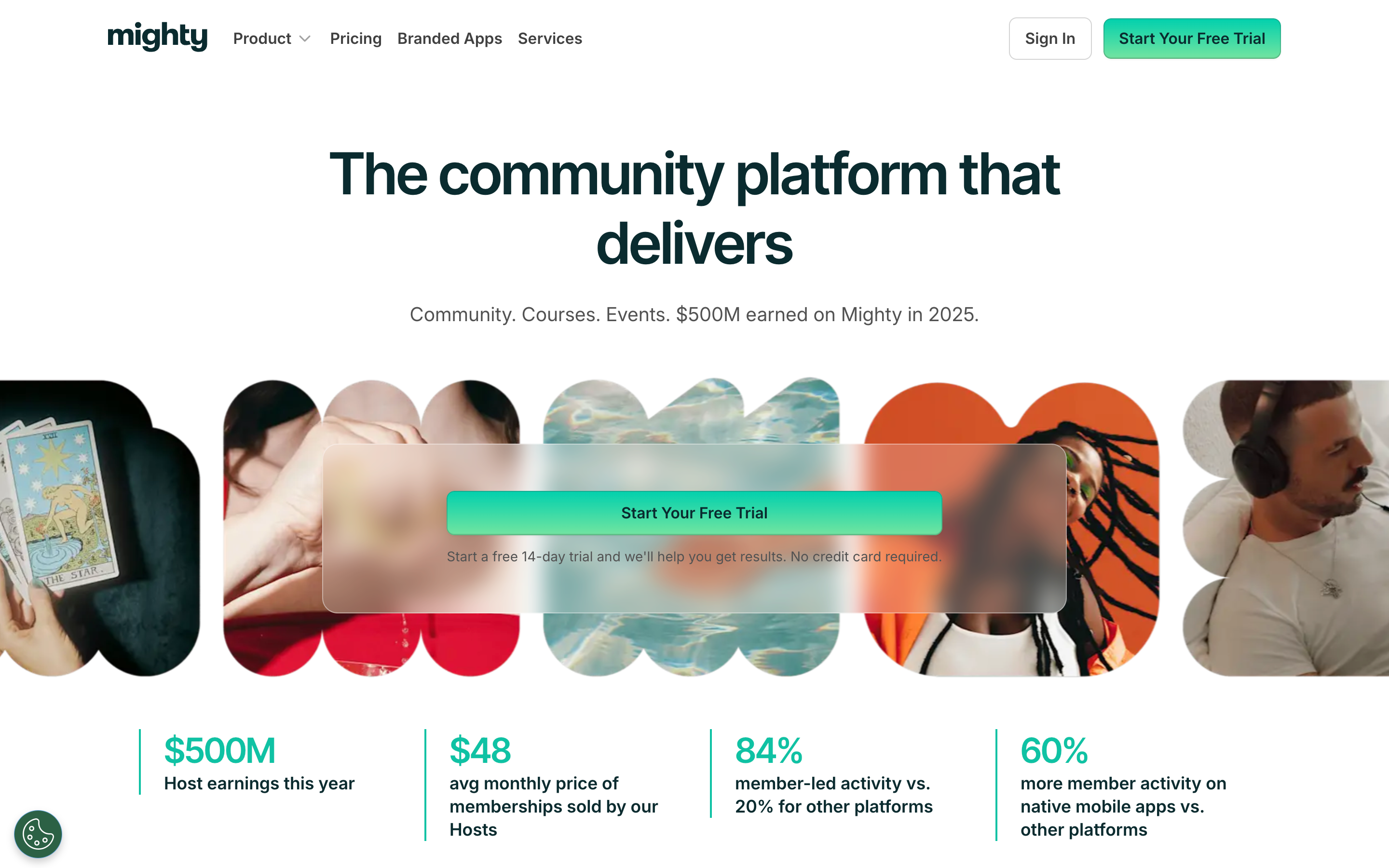
Mighty Networks offers branded community spaces, courses, events, livestreams, and paid memberships. The differentiator is native mobile apps (not web wrappers) and what they call "Community Design," a framework for building engaged communities. $500M+ earned by hosts in 2025.
Key features:
- Branded community spaces with discussion forums
- Course hosting with drip content
- Events and livestreaming
- Native iOS and Android apps (branded on Pro)
- AI Cohost for community management
Pricing: Starts at $95/mo + 2% transaction fee.
Pros:
- Native mobile apps drive 60% more member activity vs. web
- Strong community engagement tools
- AI Cohost handles onboarding and re-engagement
Cons:
- Less suited for traditional membership sites or SaaS
- Limited CRM and billing flexibility compared to dedicated tools
- Community-first approach may not fit businesses that need deep gating or developer access
Skool
Best for: New community builders and small creators who want a simple, low-cost platform with good engagement tools.

Skool is the simplest community-plus-courses platform on this list. It strips out complexity and focuses on what works: discussions, courses, gamification, and a clean interface. If Circle and Mighty Networks feel like too much, Skool is the minimalist alternative.
Key features:
- Unlimited members and courses
- Discussions with gamification (leaderboards, levels)
- Unlimited live streaming
- Advanced analytics
- Simple pricing with no hidden features behind tiers
Pricing: Starts at $9/mo with a 10% transaction fee.
Pros:
- Extremely easy to set up and use
- Low starting price ($9/mo)
- Strong engagement through gamification
- Clean, distraction-free UX
Cons:
- Very limited customization; no white-label or branding control
- Basic course features (no native video hosting, quizzes, or certifications)
- No CRM, email marketing, or help desk
Associations, Clubs, and Nonprofits
These platforms add features that associations and nonprofits need: event management, dues tracking, chapter management, donor tools, and compliance features. They're built for organizations, not individual creators.
Wild Apricot
Best for: Small to mid-sized associations and nonprofits that want membership management with a built-in website builder.
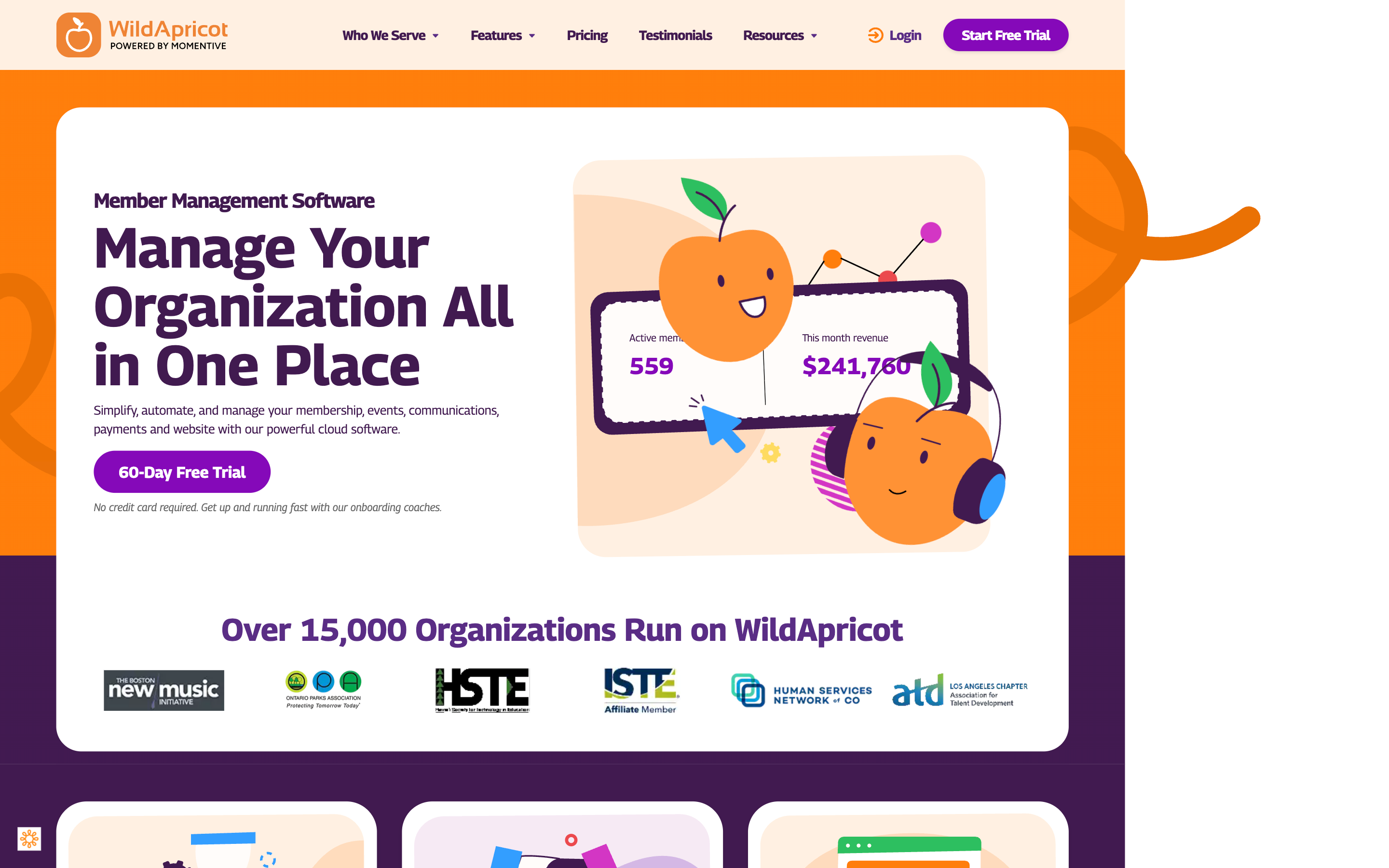
Wild Apricot has been in the membership management space since 2006. Organizations use it for member data, event registration, recurring billing, email, and a drag-and-drop website builder. It is now part of the Personify family alongside MemberClicks.
Key features:
- Member database with self-service portal
- Website builder with templates
- Event management with registration and payment
- Recurring membership billing
- Email campaigns and newsletters
- Mobile app for members
Pricing: Starts at $66/mo for up to 100 contacts.
Pros:
- Feature-rich for associations
- Built-in website builder for orgs without a site
- 1,000+ integrations via Make
Cons:
- Interface feels dense, clunky, and dated
- Very limited design capabilities for websites
- Many complaints of unreliable email and support
- Acquired by private equity multiple times now; repeated price increases
Glue Up
Best for: International associations, multi-chapter organizations, and event-heavy nonprofits.
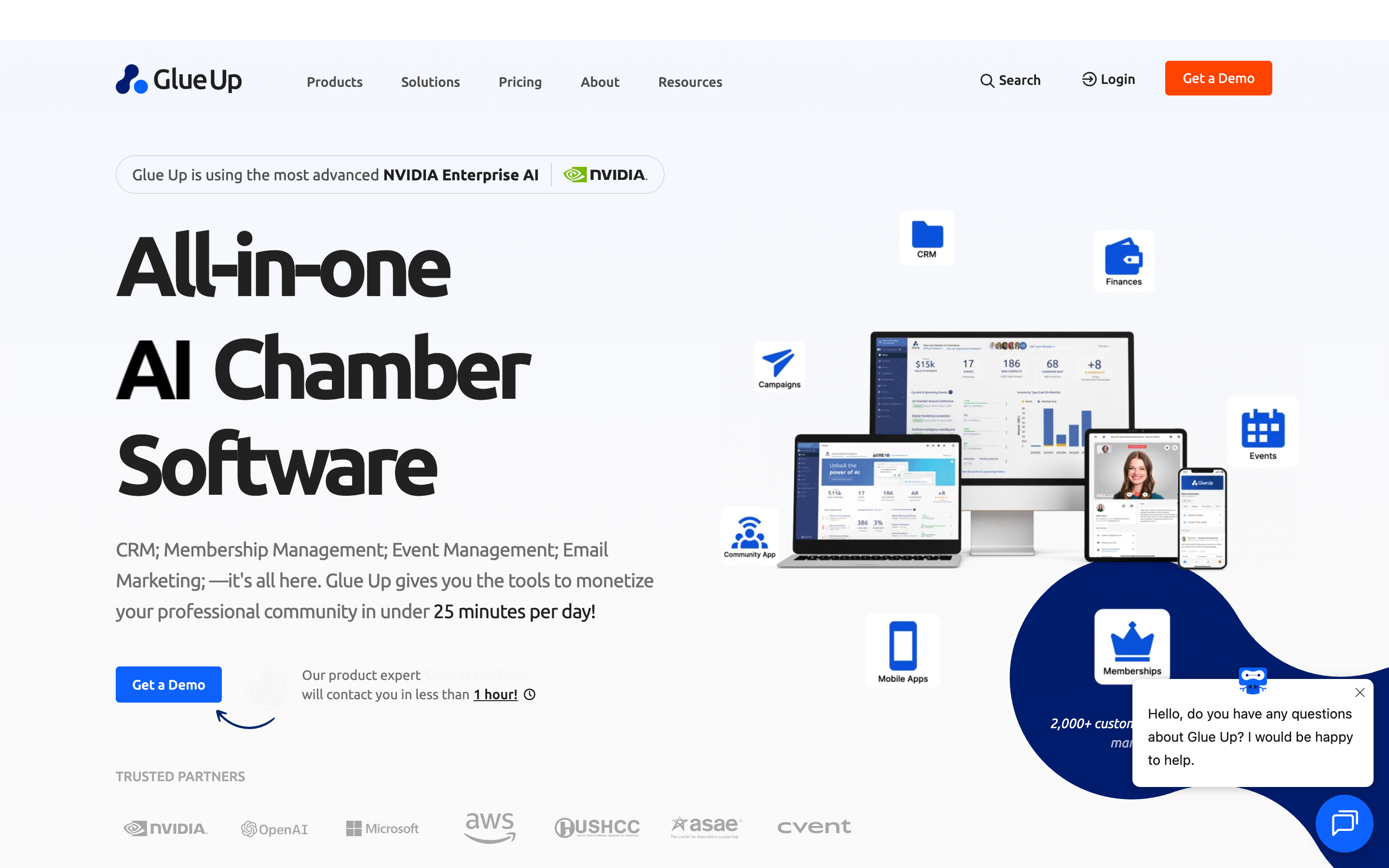
Glue Up is an all-in-one association management platform with CRM, events, memberships, email, community features, and finance tools. It stands out for multi-currency support, chapter management, and AI-powered engagement scoring. If your organization operates across multiple countries or regions, Glue Up is built for that complexity.
Key features:
- CRM with membership lifecycle tracking and AI engagement scoring
- Event management for in-person, virtual, and hybrid events
- Chapter management for multi-location orgs
- Private member communities and discussion boards
- Multi-currency payment processing
Pricing: Starts at $3,000 (annual only).
Pros:
- Strong for international orgs with multi-currency and multi-language
- Robust event management (in-person, virtual, hybrid)
- AI-powered engagement and CRM tools
- Community features most association tools lack
Cons:
- Enterprise pricing; not accessible for small orgs
- No self-serve signup; requires sales call
- Can be complex for simple membership needs
JoinIt
Best for: Small to mid-sized clubs, associations, HOAs, alumni groups, and community orgs that need straightforward membership management.
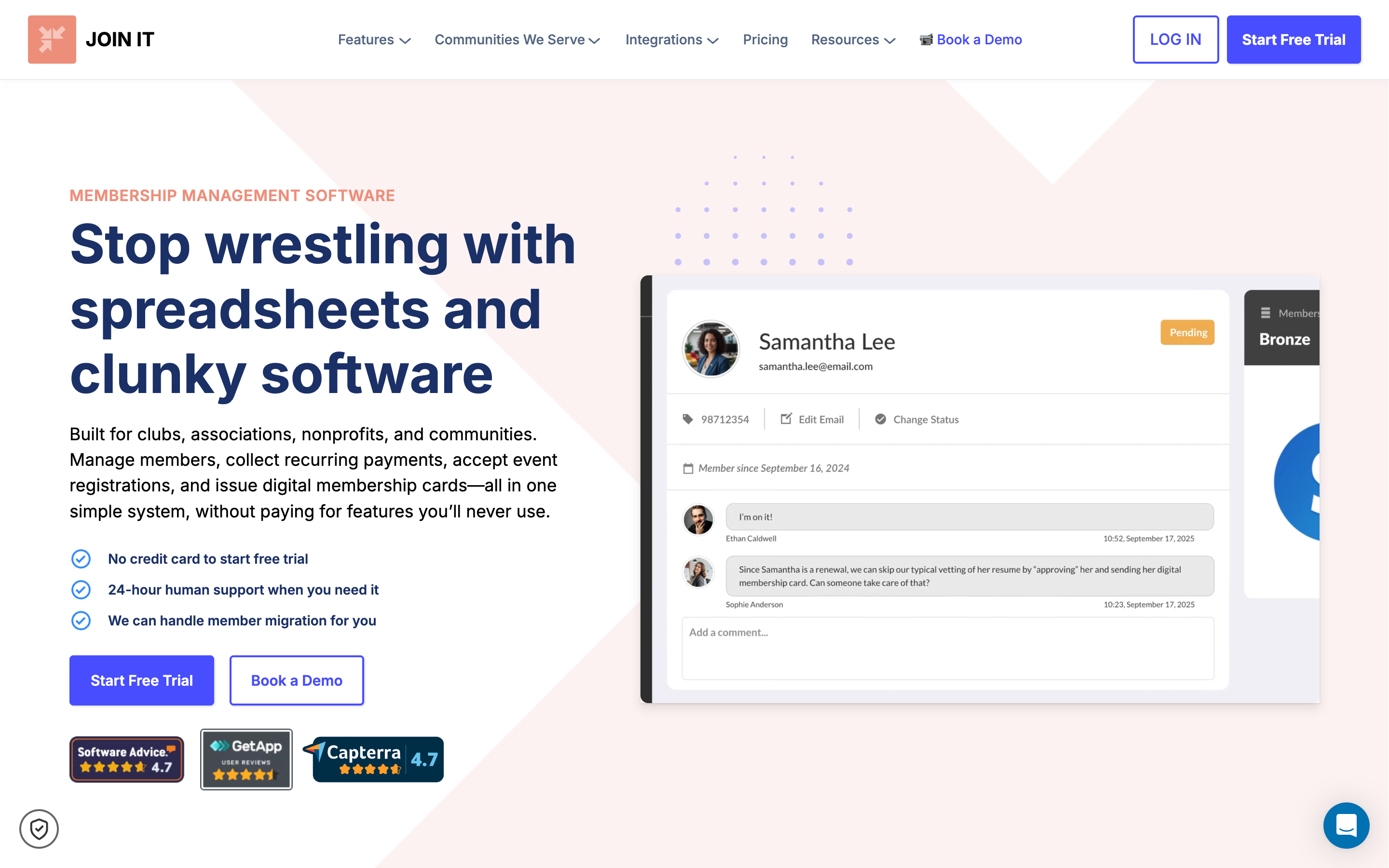
JoinIt focuses on the basics: member management, dues collection, renewals, and digital membership cards. It integrates with WordPress, Zoom, Zoho CRM, and Slack. If you need simple, affordable membership tracking without the complexity of a full association platform, JoinIt is a good option.
Key features:
- Unlimited membership types with recurring billing
- Digital membership cards (Apple Wallet and Google Wallet)
- Member directory and event check-in
- Email campaigns and automations
- Embeddable purchase widget for any website
Pricing: Starts at $29/mo with a 3% transaction fee.
Pros:
- Simple and affordable for small orgs
- Digital membership cards included
- Good integrations for the price
Cons:
- 3% transaction fee on top of Stripe fees adds up
- Branding removal and custom domains only on higher plans
- Limited features compared to full association platforms
MemberClicks
Best for: Professional associations, trade associations, and chambers of commerce with budget for a full AMS (association management system).
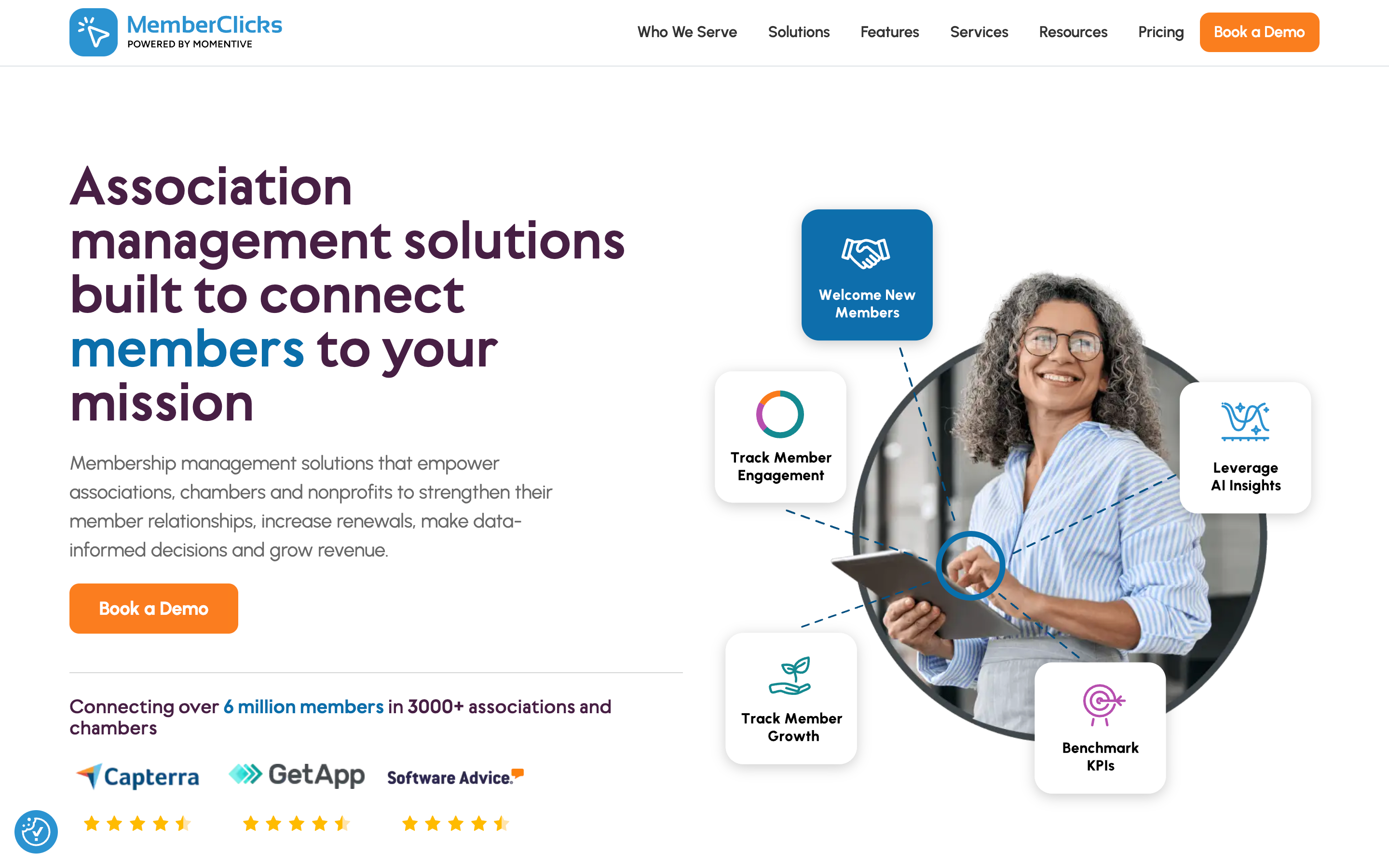
MemberClicks (now part of Personify / Momentive Software) is purpose-built for associations. It handles membership management, dues, events, email marketing, CRM, website hosting, and reporting. Unlike most tools on this list, it understands the association model where members are organizations, not just individuals.
Key features:
- Membership database with tracking and segmentation
- Automated dues renewals and invoicing
- Event management with registration and payments
- Email marketing with segmentation and scheduling
- CRM and reporting with AI-powered data insights
- Website builder and forms
Pricing: Starts $4,500 (annual only).
Pros:
- Purpose-built for associations; understands org-based membership
- Comprehensive AMS: dues, events, email, CRM, website in one
- Strong support and implementation services
- Add-ons for LMS, job board, community, mobile app
Cons:
- Expensive; not accessible for small organizations
- Interface can feel dated compared to modern SaaS tools
- Complex setup and onboarding
Membership Software (Stack-Specific)
These tools focus on adding membership, gating, and payments to your existing website or app. Each is tied to a specific platform: Webflow, Framer, WordPress, or multi-platform.
Memberstack
Best for: Webflow users who need membership gating and Stripe payments without leaving the Webflow ecosystem.
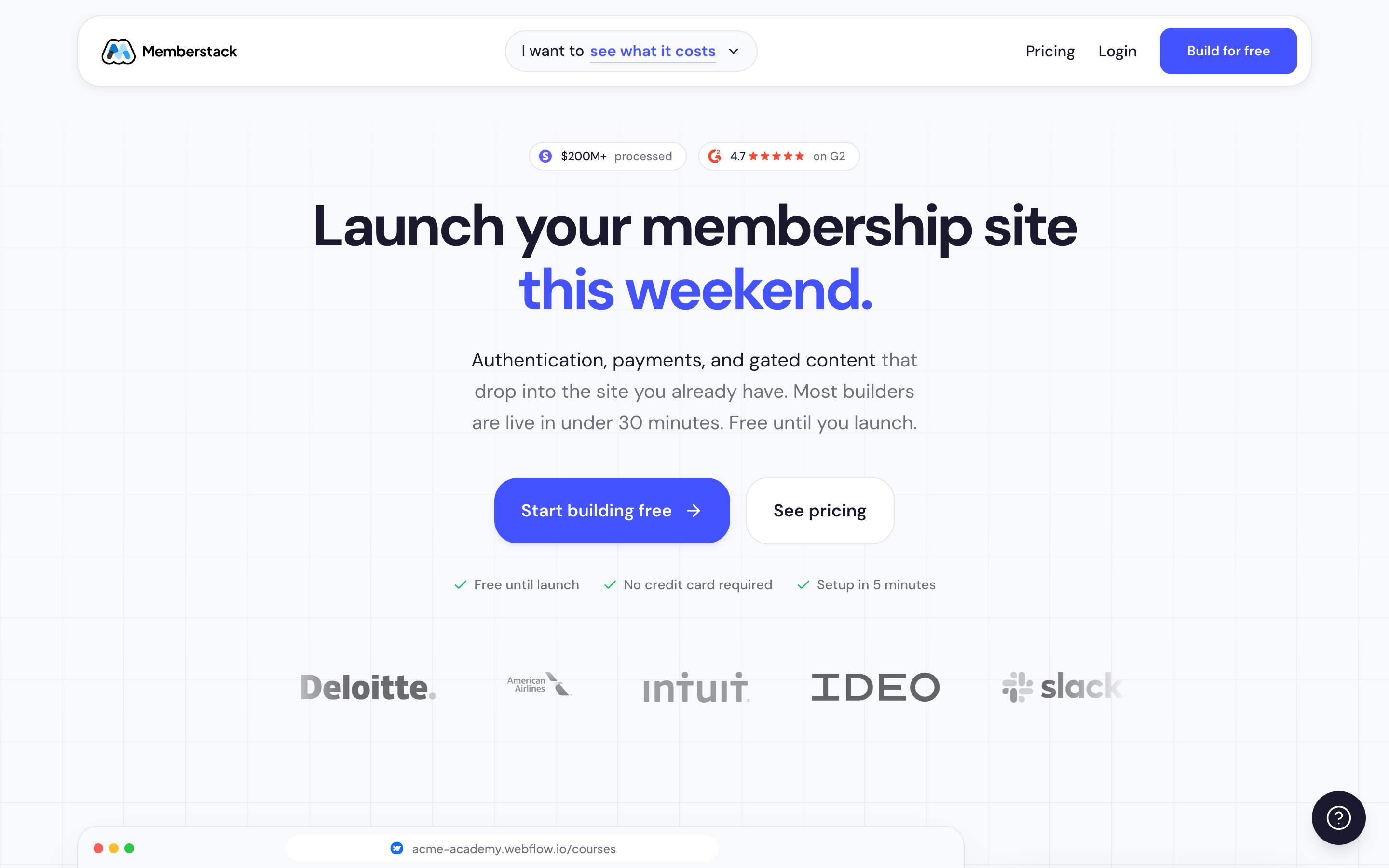
Memberstack makes adding gated content to a Webflow site easy—add their script, configure plans, and protect content with attributes. It handles authentication, payments via Stripe, and content gating. Memberstack is also commonly used with Wordpress—much of their documentation is written for both Webflow and Wordpress users.
Key features:
- Membership gating for Webflow
- Stripe integration for subscriptions and one-time payments
- Custom login/signup components
- Plan-based content access
- Member data and dashboard
Pricing: Pricing starts at $29/mo with a 4% payment processing fee paid in addition to Stripe fees
Pros:
- Deep Webflow integration
- Quick setup: add script, configure, launch
- Free during setup period
- Good documentation and community
Cons:
- Primarily Webflow-focused; less capable on other platforms
- Total payment processing fees start around 7.6% per transaction (4% Memberstack fee, 2.9% Stripe transaction fee, .7% Stripe Billing)
Learn more about alternatives to Memberstack.
Thenty
Best for: Framer users who want authentication, membership gating, and Stripe payments on their Framer site.
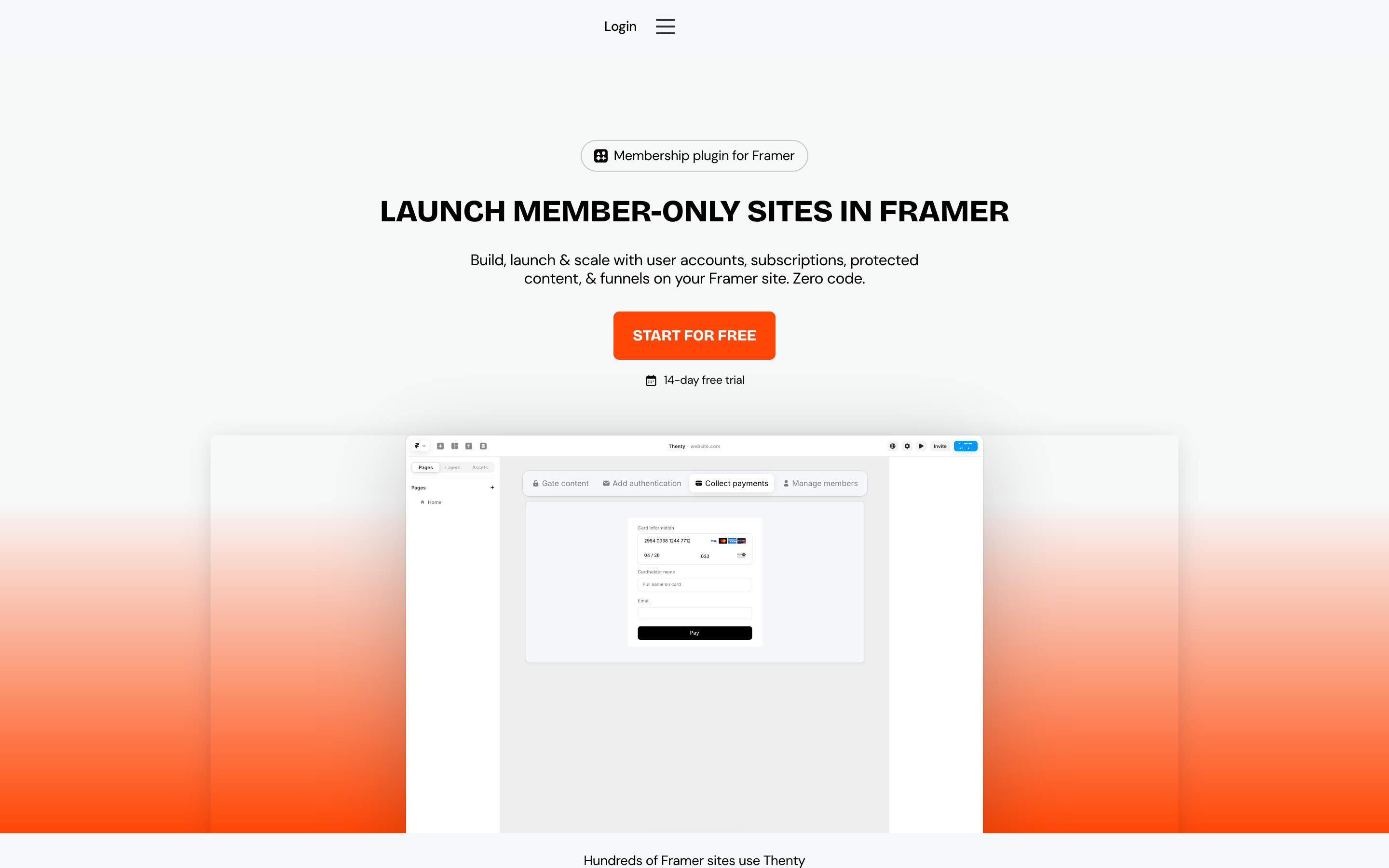
Thenty is the Framer equivalent of Memberstack. It's a plugin that adds login, signup, gated content, and Stripe payments to any Framer site. Designed specifically for the Framer ecosystem, it gives you full design control with zero code.
Key features:
- Login and signup forms with Google SSO
- Stripe integration for subscriptions and one-time payments
- Gated pages and member-only content
- Member dashboard and custom fields
- Zapier and Rewardful integrations
Pricing: Starts at $24/mo + 1.5% transaction fee.
Pros:
- Built specifically for Framer; full design control
- Stripe integration with subscriptions and one-time payments
- Google SSO included
Cons:
- Framer only; not compatible with other site builders
- No CRM, email, or help desk
- Newer product; less mature than many alternatives
Memberspace
Best for: Creators on Squarespace, WordPress, or Webflow who need content gating and membership payments.\
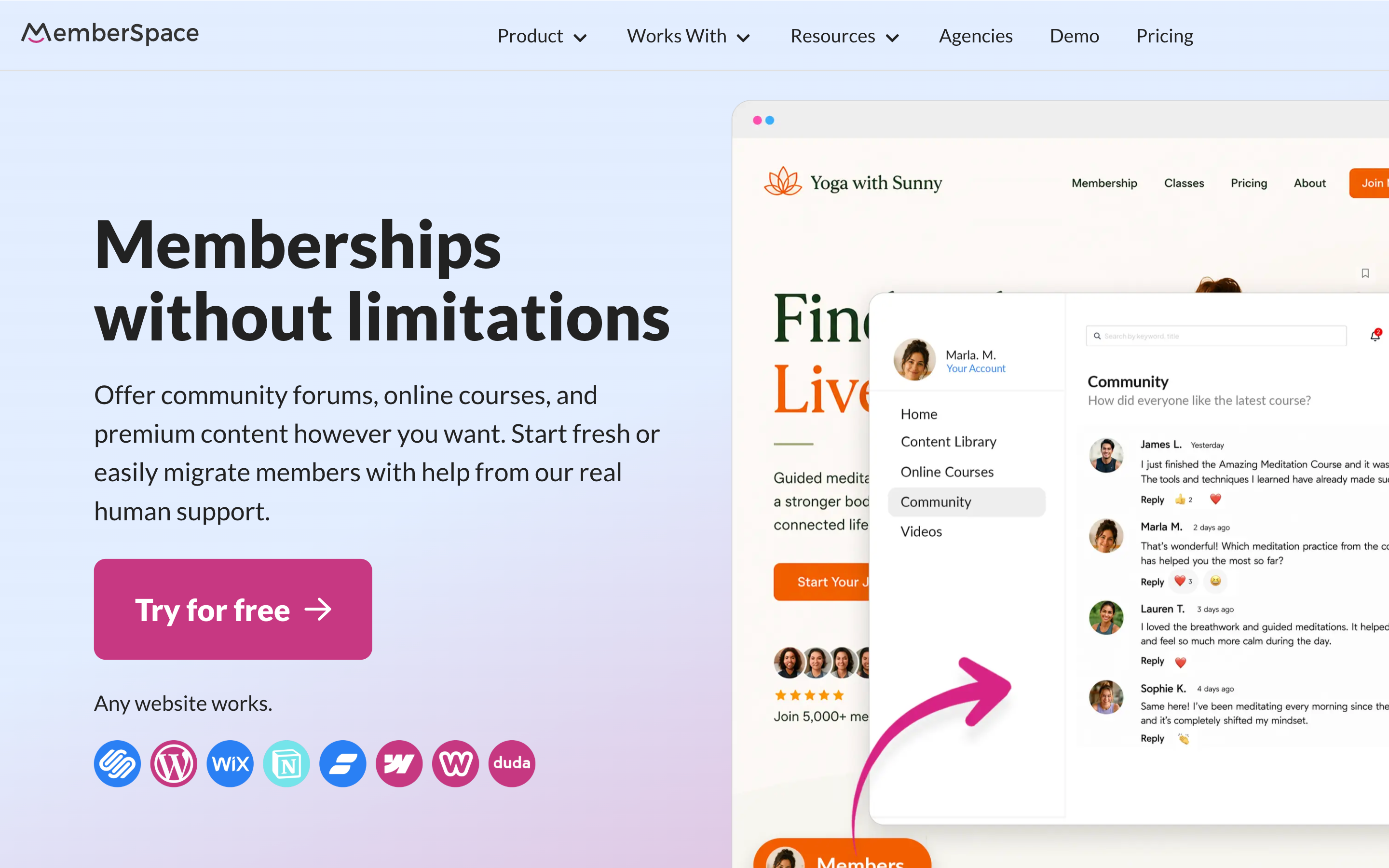
Memberspace works across multiple website platforms. Add the code snippet, lock content, and start charging. It supports Squarespace, WordPress, Webflow, Wix, Notion, and more.
Key features:
- Content gating across Squarespace, WordPress, Webflow, Wix, Notion, and more
- Stripe payments for subscriptions and one-time purchases
- Multiple membership tiers
- Member areas with content hub
- Apple Pay and Google Pay support
- Automated retention tools (cancel-save flows)
Pricing: Starts at $39/mo with a 5% transaction fee.
Pros:
- Works with almost any website platform
- Strong Squarespace integration
- Automated retention features
Cons:
- No CRM, email marketing, or help desk
- Limited to content gating and payments
- High payment processing fees to start (5% + Stripe fees)
- You'll need additional tools as you grow
MemberPress
Best for: WordPress users who want a mature, feature-rich membership plugin with courses and content gating.
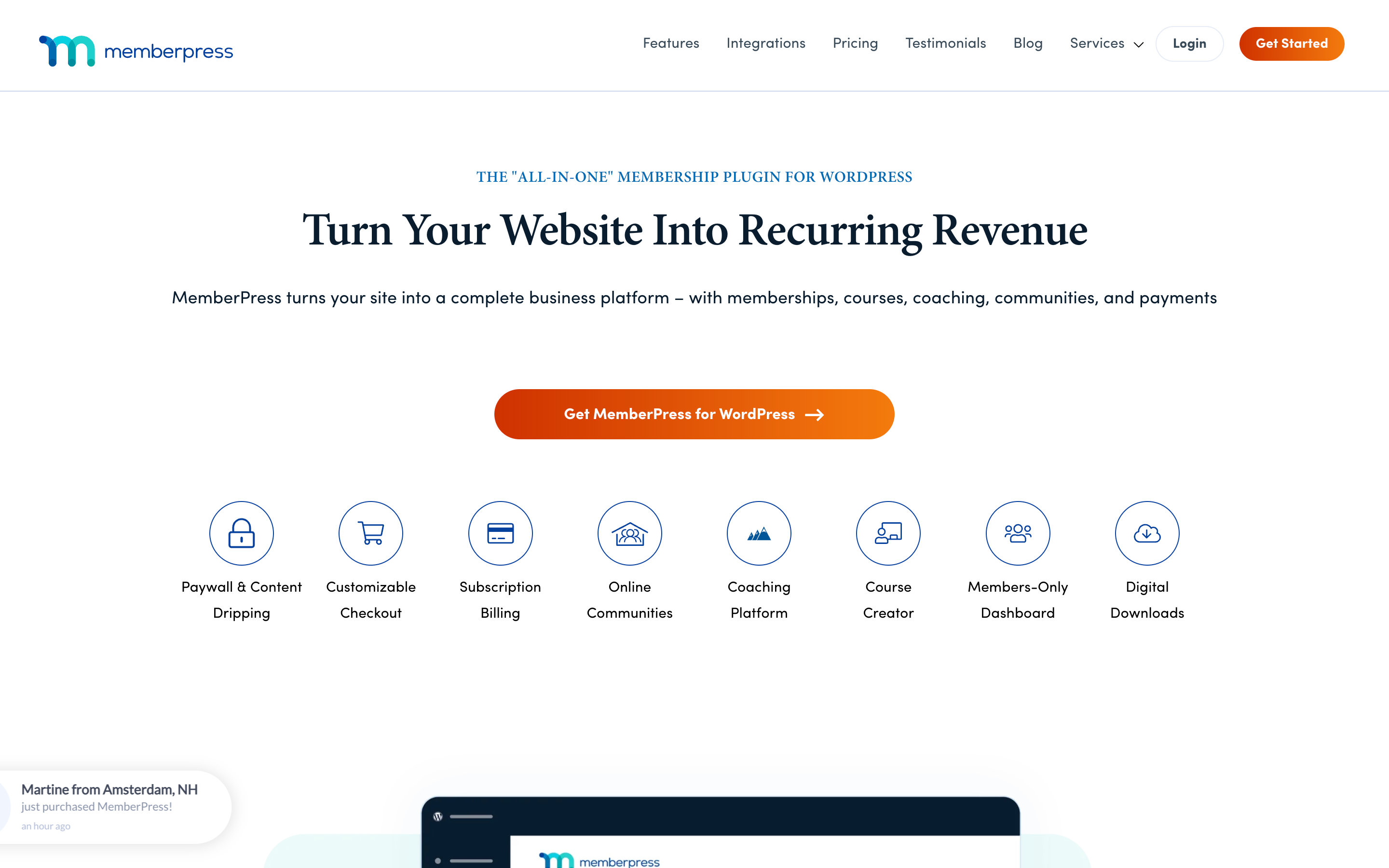
MemberPress is the most popular WordPress membership plugin, with creators earning $2.5B+ through the platform. It handles content gating, drip content, multiple membership levels, Stripe and PayPal payments, and includes course-building tools. If your entire business runs on WordPress, MemberPress is the standard.
Key features:
- Content gating with flexible access rules
- Multiple membership levels with drip content
- Built-in course creator and LMS
- Stripe, PayPal, and Authorize.net payments
- Digital downloads and coaching products
- Members-only dashboard
Pricing: Starts at $199/year with a 4.9% transaction fee.
Pros:
- Most mature WordPress membership plugin
- Comprehensive content restriction and drip capabilities
- Built-in LMS for courses
- Large ecosystem of add-ons and integrations
Cons:
- WordPress only; if you leave WordPress, you rebuild everything
- No CRM or help desk
- Annual pricing only pricing with high transaction fees
How All 16 Platforms Compare
Here's how each tool stacks up across the key features from Section 1. A quick reference to help you narrow your shortlist.
The pattern is clear: nearly every tool handles billing and some degree of protected content. Relatively few include tools like CRM, email, and help desk; the tools you'll need to operate and grow your membership organization day-to-day. Outseta is the only platform that covers all five. Kajabi comes closest but lacks a help desk and starts at $179/mo.
What this means in practice: If you choose a billing-and-gating-only tool, you'll likely need to add a CRM, an email marketing platform, and possible help desk software too. That's three additional subscriptions, three logins, and the ongoing work of keeping member data in sync. For some businesses, that modular flexibility is worth it. For others, consolidating into a tool like Outseta saves real time and money.
It's also worth noting which platforms actually deliver your website or content, versus platforms that integrate with your existing website or content. Your website is often your first impression on prospective members, so how you deliver your site is a really important consideration and likely one that will help steer you towards some of these platforms versus others.
Finally, features like event registration are often really important in certain contexts—like if you're running a professional association or a local community. Some platforms include this by default; with others, you might need or prefer to integrate with a third party event registration platform like Luma.
How to Choose the Right Software for You
Choosing the right tool comes down to three questions:
What am I building? (creator business, protected content site, SaaS, professional or trade association),
What's my tech stack? (Webflow, WordPress, Framer, Squarespace, custom code, etc.)
How many separate tools do I want to manage? (Do you want to integrate a handful of best-in-class software tools or manage everything in one place?)
Here's how we'd narrow the list by segment.
What is the best membership software for associations and non-profits?
If you manage dues, chapters, events, and member directories, the tools to evaluate depend on your size and budget:
- Small to mid-sized associations and non-profits: I'd look at Outseta or JoinIt. Both represent modern software at an affordable price that can integrate with your own website. Wild Apricot is just too dated and clunky for me to honestly recommend.
- Large multi-chapter associations: MemberClicks and Glue Up are generally more geared towards large international organization with multi-chapter needs and frequent events.
What's the difference between membership software and association management software (AMS)?
Membership software is the broad category for anything that charges recurring access: billing, gated content and member data, for creators, communities, SaaS and courses.
Association Management Software (AMS) is a subset built for associations and nonprofits. It adds dues cycles, events, chapters, member directories and organization-level memberships.
Every AMS is membership software, but not every membership tool is an AMS.
What is the best membership software for creators and course builders
If you sell courses, coaching, or community access, here's how to narrow it down:
- Full business platform (courses, funnels, email, community): Kajabi is the most complete plug-and-play platform but also the most expensive. It's a good option if you're running a serious knowledge business, but aren't yet at the level where you want to build a more custom home for your business.
- Community-first businesses: Circle and mighty Mighty Networks are good options.
- Fan-supported creator model: Patreon is for great creators with existing audiences if you're OK with the fees. Podia is great for solo creators who want a website, store, and email in one.
If your creator business also needs CRM, email automation, and member support without bolting on additional tools, Outseta covers you well. Outseta is best suited to creator business who want to sell access to products on their own website.
What is the best membership software for SaaS and digital products?
If you're building a SaaS product or membership site and want billing, auth, CRM, email, and support in one tool, Outseta is a particularly strong in being tech stack agnostic and offering robust APIs. It gives you the most freedom to build across different platforms—in fact, our own SaaS business runs entirely on our software!
What is the most budget friendly membership software?
There's no truly free membership platform with zero trade-offs, but several offer low-cost entry points:
- Patreon: Free to start, but you pay 10% platform fee
- Skool: $9/mo Hobby plan, but with 10% transaction fee on paid memberships
For most businesses past the initial testing phase, a paid tool pays for itself through automation (no manual renewal chasing), better retention (professional member experience), and time savings (one dashboard instead of five).
Common Mistakes When Choosing Membership Software
Buying for features you don't need. Association tools add event sponsorships, chapter management, and donor CRM. If you run a creator business or SaaS, you don't need those, and paying for them adds complexity and cost. Match the tool to your actual use case, not the longest feature list.
Ignoring the total cost. A $29/mo tool with a 3% transaction fee on $100,000 in annual revenue costs $3,000 in fees alone, bringing the real annual cost to $3,348. A $87/mo tool with a 1% fee costs $2,044 total. Always calculate subscription + transaction fees together.
Locking into a website builder you don't want. Some tools bundle a website builder (Wild Apricot, Kajabi, Podia). If you already have a site on Webflow, Framer, or WordPress, that builder is dead weight. Your website is arguably your biggest marketing asset—I always suggest that you treat it as such.
Skipping the member-facing experience. Admin dashboards can look great while the member signup, login, renewal, and profile flows are clunky. Always test both sides. Members judge you by the experience they see, not the dashboard you see.
Starting with free and hitting a wall. Free tools are great for testing, but they often lack automation, branding control, or essential features. Migrating 500+ members to a new platform later is far more painful than choosing the right paid tool from the start.
Frequently Asked Questions
How much does membership management software cost?
Prices range from free (Patreon) to $15,000+/yr (Glue Up Pro). Most platforms for creators and small businesses fall in the $30-$150/mo range. Association tools typically cost $1,000-5,000/yr. The biggest hidden cost is transaction fees: some tools charge 1.5-10% on top of Stripe's base 2.9% + $0.30. Always calculate total cost including transaction fees, not just the monthly subscription.
Can I manage memberships for free?
Yes, but with trade-offs. Patreon charges no monthly fee but takes 10% of earnings plus payment processing. Skool starts at $9/mo with a 10% transaction fee. For most businesses beyond the early stage, a paid tool pays for itself through better automation, fewer manual tasks, and higher retention.
What's the difference between a CRM and membership software?
A CRM (customer relationship management tool) like Hubspot or Salesforce tracks contacts and interactions across your sales pipeline. Membership software specifically handles recurring billing, content gating, member portals, and access control. Some tools combine both (Outseta, Kajabi). Others handle membership but leave CRM to a separate tool (MemberPress, Patreon). If you need both, an integrated solution saves you from syncing data between platforms.
Do I need a developer to set up membership software?
Not always. Platforms like Podia, Skool, and Patreon require almost no technical skills. Tools like Outseta, Memberstack, Thenty, and Memberspace need you to paste a code snippet into your site header (a 2-minute task). WordPress plugins like MemberPress need a WordPress installation. Ultimately the technical skill required to implement membership software depends a lot on the website builder and combination of tools you're planning to use.
Can I switch membership platforms later?
Yes, but it's painful. Member data can be exported from most platforms, but you'll need to re-create plans, re-invite members, and potentially re-collect payment information. Some platforms (Outseta, Circle, MemberClicks) offer migration support. The best time to choose the right tool is before you scale, not after you have thousands of members locked into a platform.
Final Thoughts
The right membership management software depends on what you're building and who you're building it for.
Whatever you choose, the most important thing is consolidating your stack so member data, billing, and communication live in one place. The fewer tools you juggle, the less time you spend on admin and the more time you spend on what your members actually signed up for. Memberships thrive when you focus on building relationships rather than wrestling with your software tools.
Take the time to run a trial before committing. Import a sample of real member data, test the signup and renewal flow as a member, and have your least technical team member try the admin dashboard. If they can't figure it out, neither will your team at scale.
Ready to consolidate your stack? Start your free trial with Outseta and see how payments, auth, CRM, email, and help desk work together in one platform.
On this page
Get our newsletter
Try Outseta free for 14 days—you'll have access to every feature. Cancel any time.
