Lessons From 10+ Years of Self-Management
Reflections on building a business with no job titles, no bosses, and no hierarchy.


Yesterday Beehiiv announced that it’s getting rid of job titles. I watched the reactions flood Twitter, ranging from people celebrating the spirit of the move to others calling it performative. It was the kick in the ass I needed to finally write a post I’ve been meaning to write for a long time.
Outseta has operated without job titles, bosses, or hierarchy for 10+ years.
I’ve heard every perspective under the sun on this topic, almost always from people who have never actually operated this way.
Our model is imperfect, but if I had to start Outseta over, I’d do it exactly the same way.
Most of this post is about Outseta’s experience, but I’ll start and end with some thoughts on Beehiiv.
My reaction to Beehiiv dropping job titles
The mixed reactions to the announcement are warranted, in both directions. Let’s start with the positive.
First, I applaud Tyler Denk, Beehiiv’s CEO, for being willing to experiment with operating differently. There’s so little innovation in how we build companies today, and I love to see it. I have nothing but praise for the spirit of the announcement.
Tyler says job titles create operational complexity, people jockeying for position, and time wasted defining salary bands. All of that is very real, and it adds up. He’s trying to make sure the team at Beehiiv is focused entirely on creating value for customers, an idea we’ve taken to heart at Outseta as much as any business I know. Our decision to operate the way we do was partly born out of rejecting that same stuff.
I also like his comparison to the Yankees not putting players’ names on the back of their jerseys. They’re all just playing for the Yankees. The spirit of the announcement is “we’re putting the company first and focusing everyone on that,” and I think that’s awesome. This is an area where the business world can learn a lot from sports.
Now the harder part: just dropping job titles accomplishes almost nothing. If there are still differences in pay, differences in authority, a clear reporting structure, and no real change in how decisions get made, then it’s purely performative. All the underlying elements of hierarchy remain; they just don’t have labels anymore. If anything, you risk creating an environment that’s still hierarchical, just less organized.
I don’t know Tyler and I don’t know his intentions, but if I leave you with nothing else, it’s this:
If Beehiiv is just dropping titles and nothing else changes, it’s almost entirely pointless. If they’re also making fundamental changes to how they operate, it has the potential to become a real competitive advantage.
That’s what I think Beehiiv needs to decide.
How Outseta operates without job titles
Now let’s turn to Outseta. To be clear, I’m not suggesting Beehiiv should replicate any of what follows (they shouldn’t, and couldn’t). But it’s useful context for understanding the conditions that make a less hierarchical business more feasible.
In short:
- There are no job titles, bosses, or positional hierarchy at Outseta
- Everyone is paid the same standardized salary of $210,000/year
- Everyone can choose to work anywhere from 1 to 5 days per week
- Everyone earns equity on the same terms as the founders (and everyone else)
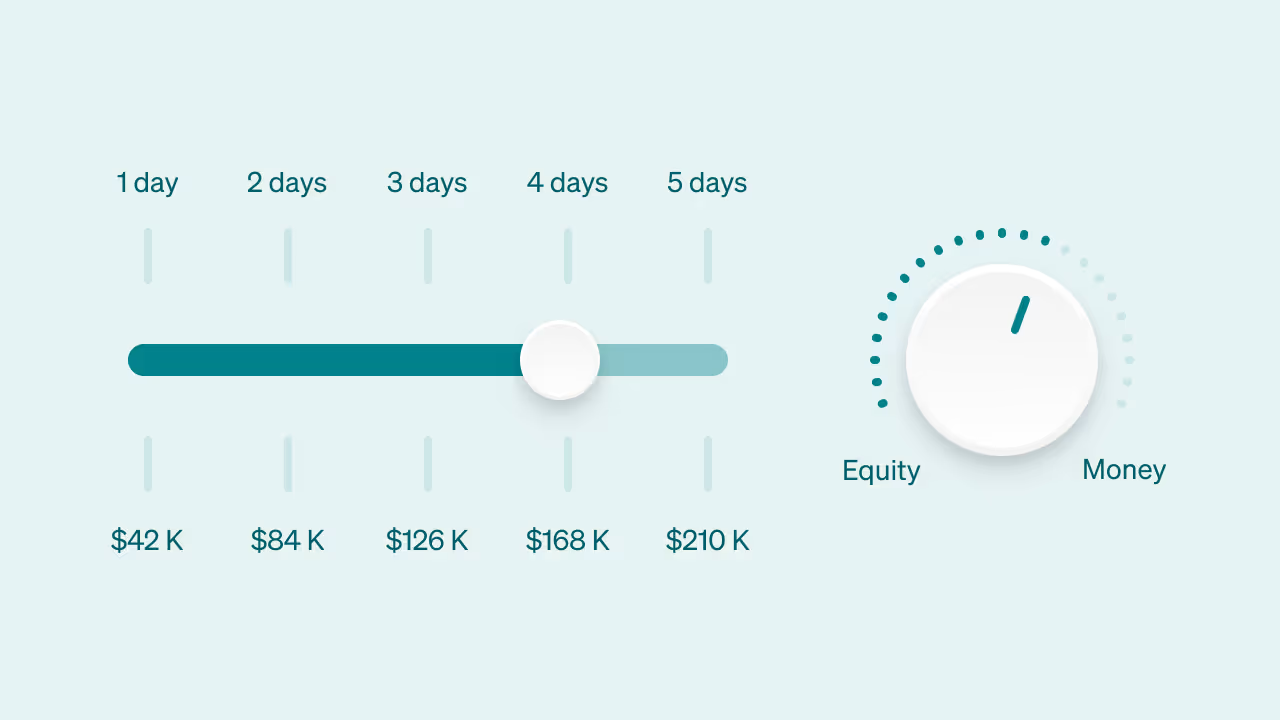
We’ve operated this way since day one. It came from wanting to keep the team as small as possible and to empower people to make decisions autonomously. We did the VC track (the one Beehiiv is on now) at a previous company and decided it was simply a lot more fun to run a company of 20 people than 200.
The idea was to hire the best people we possibly could, then set them free to contribute wherever they were most interested and able. We still do that today. You contribute where you can, not within some predrawn circle of responsibilities attached to your title.
Our team does loosely self-identify by the area they focus on most: James is “Design”; Dave, Bernard, and Pierre are “Engineering”; you get the idea. But fundamentally, no one is anyone’s boss. Everyone has complete transparency into all of our business data, everyone owns a significant percentage of the company, and we believe that creates enough alignment that traditional hierarchy isn’t needed.
That’s really the core lesson of this post: in the absence of positional hierarchy, you need well-defined processes to govern how the business operates.
We defined ours early on in our operating agreement. In our case, it means that even though we started the company, Outseta’s co-founders don’t have the authority to sell it. That’s something the whole team would vote on.
That’s our own flavor of organizational design. My point is that if positional hierarchy goes away, you damn well better design processes to replace it.
This is arguably the main point of Frederic Laloux’s Reinventing Organizations, which I can’t recommend highly enough to anyone interested in this topic.
Lessons from running a self-managed business
Looking back on 10 years of running Outseta this way, these are the lessons that matter most.
It doesn’t work without 100% transparency
Operating like we do would be impossible without sharing all information about the company. You can’t empower people to make decisions on the company’s behalf if they’re working with incomplete information.
When things are going great, people know it and feel encouraged to take risks. When things aren’t going great, people have the full context and understand the constraints the business is operating under.
Equity and profit sharing create alignment
If we only paid everyone the same, there’d be little incentive to work really hard and drive the business forward. Because we issue equity generously and share profits, the team has a clear path to greater financial rewards, even on a standardized salary.
Everyone is aligned on growing the business profitably, because everyone has real skin in the game.
New hires need encouragement to find their voice
New hires are attracted to this structure, but almost all of them go through a period of adjustment. When no one is assigning you work, do you take the afternoon off once your tasks are done?
No! The whole point is that you’re trusted to be self-motivated and to spend your time on whatever moves the business forward.
Some people get this instinctively and thrive. For others, it doesn’t come naturally. When people are unhappy in this model, it’s usually because they never fully embraced the power it gives them. The rest of the team has to actively encourage new hires to step up, make decisions, and run full speed at the ideas they believe will move the business forward.
Influence is earned through great work and good decisions
Positional authority doesn’t exist, but people still earn influence by doing great work and making good decisions. That also shapes who makes decisions in different areas of the business.
My co-founder Dave makes the really hard calls on technical architecture, not me. He’s a software engineer with 30+ years of experience, and my background is mostly marketing. Of course he does!
The team leans on people in their areas of expertise and trusts those who consistently show up and deliver.
People will never deliver equal value, and that’s OK
Everyone is paid the same, but the value each person delivers will never be equal. That’s completely fine.
It’s far more reasonable to expect comparable effort than comparable value.
This is one of the biggest points of pushback against our model, and I get it. But I’ve yet to see a hierarchical organization where pay comes close to reflecting the value each person delivers. In fact, hierarchical organizations tend to be laughably bad at this.
Hiring was already the most important thing you do; now it’s even more so
Hiring is arguably the most important thing any company does, and operating this way raises the stakes further. This is a very high-trust environment by design, and people are even more sensitive to teammates who don’t pull their weight.
Equity and profit sharing go a long way toward alignment, but you still need a team full of talented, self-motivated people for this to work.
It’s easier when you’re smaller
Plenty of companies have operated without job titles at a much larger scale than Outseta. Zappos is a popular example, and Valve is another. The book Corporate Rebels has many more.
But I’ll be the first to tell you this is significantly easier as a small company. I think the model generally gets harder to make work as you scale.
You’ll still have leaders
There’s no question that I play a leadership role at Outseta. That role isn’t assigned by a CEO title; it’s simply a skill I contribute to the team. Not everyone wants to spend their days thinking about the market, where Outseta will be in five years, and pulling together data for our quarterly meetings. So they look to me for that, and that’s perfectly fine.
This is especially interesting in Beehiiv’s case. Tyler was the CEO, and now, in title at least, he’s not. Should people stop relying on his judgment to steer the company?
Of course not!
But does anything fundamentally change about how decisions are made, or does the buck still stop entirely with Tyler? If nothing changes, dropping titles was purely performative.
The people who badmouth this model have something in common
I’ve talked with many smart people who’ve told me some version of:
Geoff, this is the dumbest shit I’ve ever heard. Companies need hierarchy or it’s chaos. You can’t point to many companies doing this well. I would never operate this way.
I understand that sentiment, and they’re not entirely wrong. But there are almost always two underlying forces they hate to admit:
- They’ve never made a real, meaningful attempt to operate this way themselves.
- They simply aren’t comfortable giving up the control this model requires, and so it feels threatening to them, often subconsciously.
This model is aspirational in many ways and comes with real challenges, but the benefits are huge too. I think we’ll see models like this explode in popularity as more teams embrace AI and try to stay intentionally small.
The opportunities and challenges ahead for Beehiiv
Back to Beehiiv. The fundamental difference between us is that operating without job titles was baked into Outseta’s DNA from day one. It’s documented in our processes and our operating agreement, and we chose it because it matches how we want to run our company.
Beehiiv is a much larger, high-growth, VC-backed company adopting this mid-swim. That’s a very different beast.
Whether it’s meaningful or successful comes down:
- Is Beehiiv dropping job titles and that’s it?
- Or are they fundamentally changing how they operate?
If it’s #1, it’s a nice idea in spirit but unlikely to change much beyond introducing some chaos. The same hierarchies will remain; they’ll just go unspoken.
If it’s #2, and they make bigger changes in line with putting team success above individual accolades, that’s a much bigger opportunity.
I’m excited to see whether they can turn this into a real competitive advantage.
More of my writing on this topic:
- Self Management Skills: 7 Ways to Build an Autonomous, High-Performing Team
- The Future of Work Demands New Organizational Design
- Outseta’s Choose Your Own Adventure Compensation Model
- Outseta Operating Agreement
On this page
Get our newsletter
Try Outseta free for 14 days—you'll have access to every feature. Cancel any time.
