Our SaaS Start-up’s Equity Allocation, Expenses, and Growth After 9 Years
Year nine didn’t feel easy, but was Outseta’s best year yet


Today is exactly 9 years since we publicly launched Outseta. As we do, here’s our annual recap of our 9th year of bootstrapping our SaaS start-up!
Equity allocation
We continue to operate with our “Choose your own adventure” compensation model, which gives everyone the opportunity to work some percentage of their time earning equity in the business. Here’s how ownership of Outeta shakes out as of the end of 2025.
- Dave Wong 30.70%
- Dimitris Georgakopoulos 23.44%
- Geoff Roberts 20.61%
- James Lavine 4.66%
- Bernard Chen 17.18%
- Benedicte Raae 2.83%
- Pierre Havelaar 0.57%
A cool point of comparison here—Pierre is new to the team this year and put in 224 hours working for equity (5 ½ weeks of work). He now has an equity stake larger than what most VPs in tech companies are granted after a 4 year vesting period.
Expenses
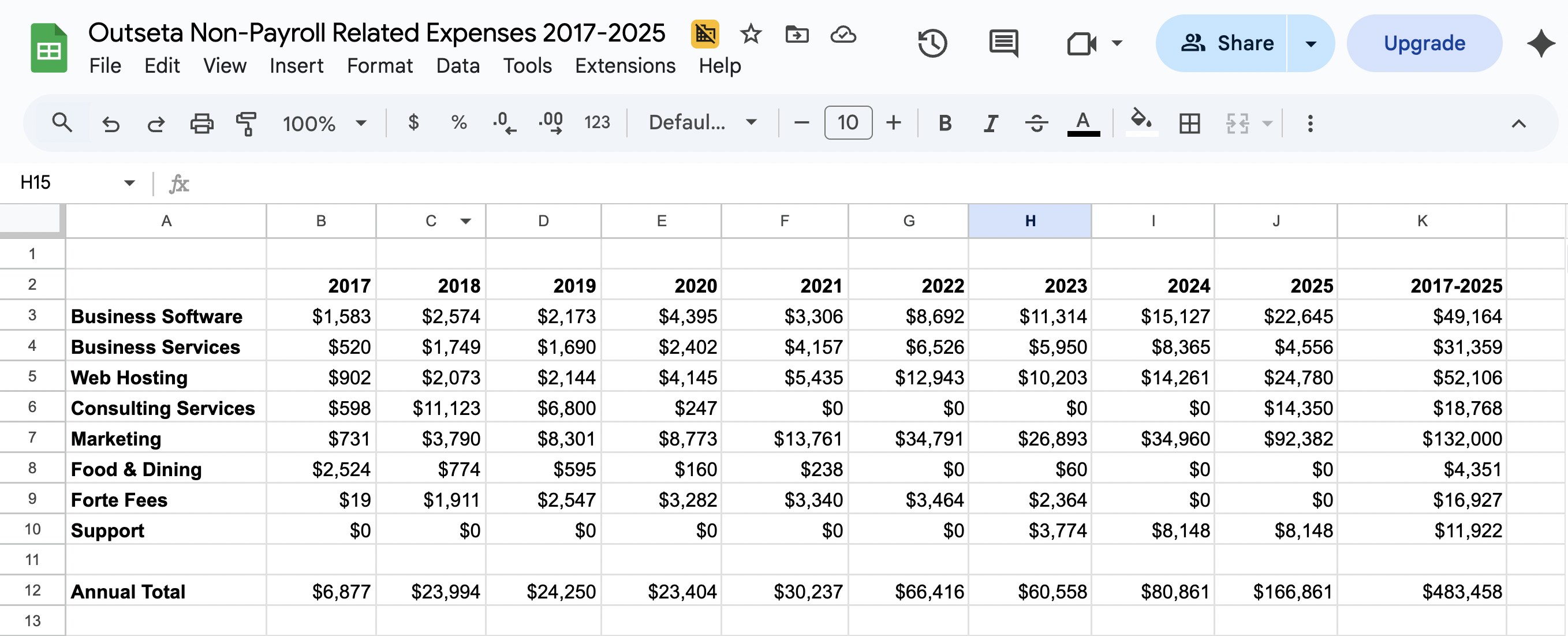
Below you’ll find a complete overview of our 2025 non-payroll related expenses (as well as the same data going back to 2017). As with past years, my takeaway here is that these expenses remain remarkably low. Almost all of our expenses at Outseta are people related—we invest in our team, and expect them to produce work that generates revenue.
Overall our non-payroll related expenses more than doubled from 2024 to 2025—resulting in expenses of $166,861 for 2025. This was mainly driven by increased costs related to web hosting and getting more aggressive with marketing spending.
A few specifics related to what’s actually included in each of these major categories of expenditures:
Business software
- Includes Cloudflare, Figma, Cursor, ChatGPT, CodeSandbox, Zapier, Sendgrid, Slack, Rollbar, Google, Loom, Tella, Unlayer, and Wistia.
Business services
- Outsourced accounting and tax prep.
Web hosting
- Amazon web services (AWS) and Webflow.
Consulting services
- Fees paid to freelancers who helped with various projects.
Marketing
- Google ads
- MicroConf conference and community membership
- Justin Welsh newsletter sponsorship
- SEO agency retainer
- Partner program payouts
- Software tools related to marketing (Framer, Wordpress, Optibase, Midjourney, Descript, Octolens, Transistor)
Product updates
On the product front, the pace at which we released new features and improvements slowed a bit in 2025 but we’re entering 2026 in a much stronger position as a result.
The first factor was just the growth of our customer base. As we’ve continued to grow the load on Dave and Bernard’s shoulders just to “keep the lights on” has increased with it. We’ve continued to make investments in system performance, stability, and reliability, most of which go relatively unnoticed. We also prioritized hiring a new engineer, Pierre Havelaar, to give our team increased capacity. We head into 2026 with Pierre now onboarded.
Additionally, Dave focused much of his work this year on what’s coming next—what we’re calling “Outseta 3.0” internally. The next iteration of Outseta offers a slew of new capabilities that customers have been looking for and will give us a better foundation to grow on going forward. Pierre also has focused much of his time since joining on a forward-looking project—he’s been focused on bringing AI into the Outseta experience to help answer customer questions. The output of both of these projects will land in our customers’ hands this year.
These themes aside, here are some of the other notable product updates from 2025.
Support ticket tags and prioritization
We added a flexible system to allow customers to “tag” support tickets to categorize and prioritize them in different ways.
Churned accounts by age report
We added a new report that looks at customer churn based on the age of the account.
User impersonation
User impersonation allows admin users to login to any account as if they were that user.
Copy overrides
This feature allows users to edit and translate the default copy used across Outseta’s customer facing components.
Quick edit CRM properties
This one is just a small usability improvement that allows you to edit individual CRM properties without needing to open and edit the full CRM record for the customer.
Reusable blocks in emails
While Outseta’s email editor has always allowed you to save your own email templates, this feature allows you to save reusable blocks or components that you can easily pull into any email.
Email performance updates
Much of Bernard’s work this year has focused on improvements to how we queue up and deploy emails. You won’t see much here, but these changes allow us to do things like check the contents of emails before sending them and deploy emails faster to larger lists.
Onboarding updates
We installed PostHog on our site (a product analytics tool) and I spent a week watching users onboard with our software. This resulted in a set of improvements focused on onboarding new customers more effectively.
We continue to give all of our customers access to every new feature and product improvement.
Growth updates
As far as growth is concerned, we had a good year in 2025. After growing revenue by 29% in 2024, we grew revenue by 55% in 2025. For a 9 year old, bootstrapped business—that’s pretty good. Best of all, this growth came without raising prices on our customers for the 9th consecutive year.
A few other data points that are interesting in terms of 2024 vs. 2025:
- We grew website traffic by 40%. Outseta remains a pretty low traffic site with about 16,000 unique visitors per month.
- We more than doubled the number of new paying customers that we signed up (107% growth).
- We increased our free trial to customer conversion rate from 33% to 40%.
In last year’s update I lamented how little time we spent on marketing—while that still felt true in 2025, I think we at least did a better job.
Marketing collaborations
A big part of our reinvigorated efforts in marketing was throwing our hands up and saying “we need some help”—so we enlisted the help of a bunch of people we’ve wanted to work with in some capacity.
Dave Mence made an awesome tutorial on using Outseta alongside Notion.
Marissa Goldberg showed the world how to vibe-code with Outseta and Lovable.
Daniel Wirtz told the story of Osmo’s $100k product launch.
Rob Hope helped us with some landing page feedback and a positioning audit.
Max Joles started working with our team on customer acquisition strategy.
These people are all awesome and Outseta is better for having collaborated with them.
Webflow sunset user accounts and membership features
Another driver of our growth this year was Webflow sunsetting their own user accounts and membership features. These features will officially be deprecated at the end of this month, but Webflow announced that these features would be sunset at this time last year.
Luckily, Outseta was one of two vendors that Webflow recommended to their customers that needed these features. We offered Webflow customers a 50% discount for a full year in order to help assure that affected customers landed in a good place. This drove a slew of migrations, particularly early in 2025, but we’re seeing a second surge in migrations now that the deadline for disabling these features is approaching.
Thank you once again, Webflow!
Paid search, SEO, and AEO
You can call it whatever you like and squabble about acronyms or tactics, but if someone is searching to buy a product like Outseta I just want them to find us! And this year saw some interesting happenings across “search.”
First, AI search (AEO?) showed up as a major new source of customers. This spanned recommendations from ChatGPT, to Gemini, to Claude but was heavily concentrated on ChatGPT. While this drove most of our growth throughout the year, the period from April to July certainly stood out and we grew faster than ever.
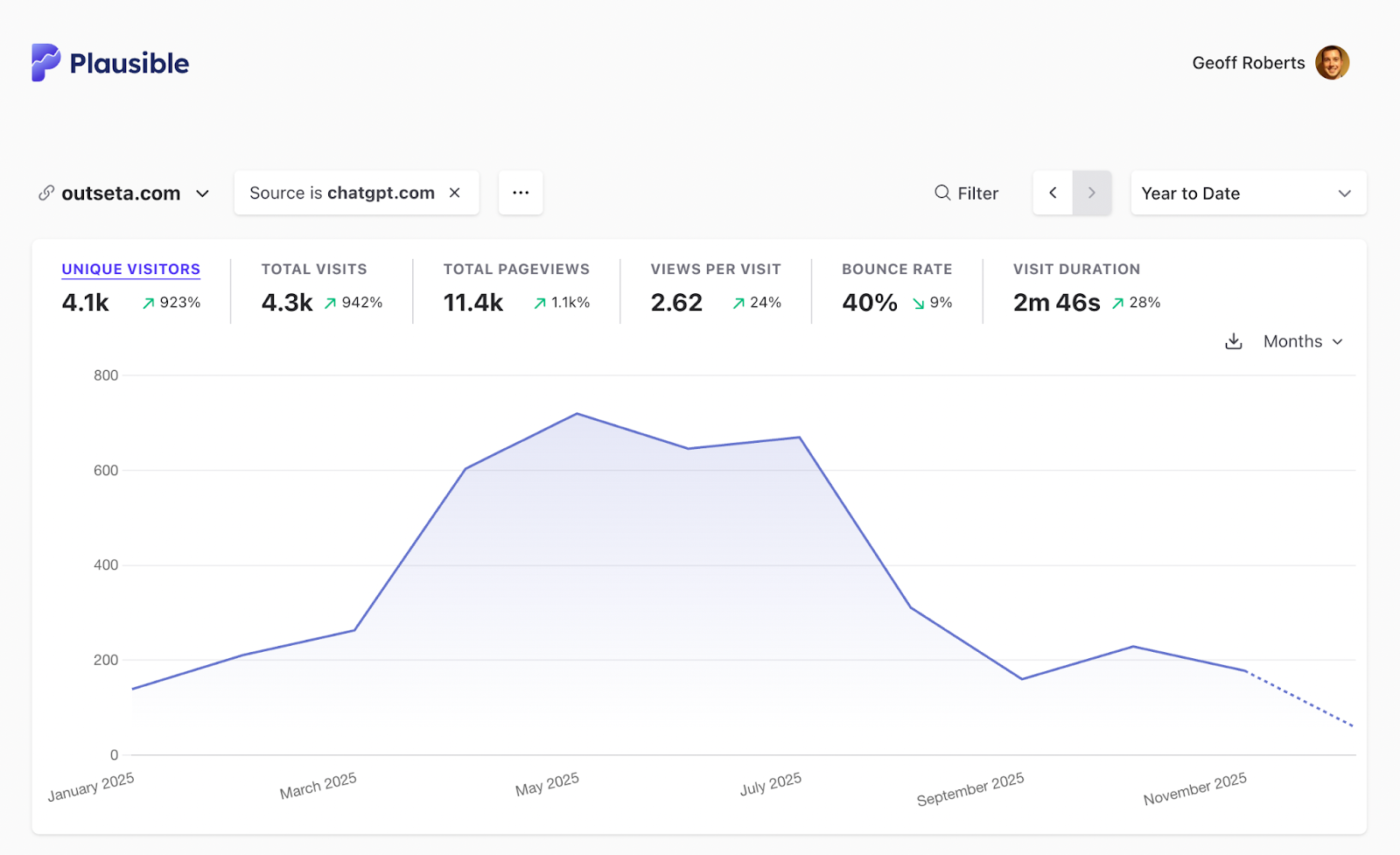
As you can see this traffic tapered off substantially towards the end of the year—I’ve heard and seen this same trend in data from many other SaaS companies too. While that’s a bummer, the takeaway from me is quite clear—“AEO” is a channel with massive potential and it’s likely going to be a relatively volatile source of customers for the foreseeable future.
The other interesting learning here is that while SEO is in some ways particularly challenging for us—given our product spans a series of hyper competitive keywords ranging from payments, to CRM, to email marketing—the breadth of our product is actually rewarded in the world of AEO. Users are not just typing in a single search term or phrase, but are instead having longer form discussions about their needs—and oftentimes the breadth of our product makes it one of the few tools that can actually deliver on the needs being described well. In short, the quality of the leads we’re seeing from AEO has been fantastic and we’re getting recommended in instances where Outseta is genuinely uniquely suited to help.
We also made our first real investments in paid advertising this year—focusing primarily on Google. We did it right, worked with a killer partner, and spent about $30k on ads over 6 months.
Paid Advertising Experiment Results
- Duration: 6 months
- Ad Spend: $30,000
- Free Trials: 69
- New Customers: 40
Verdict? Meh—we basically broke even on our ad spend.
Ultimately these results were not strong enough to warrant further investments in ads, so we decided to invest money instead into SEO. To that end we started working with the team at MagicSpace and are going to focus on building longer term, more sustainable traffic.
Grew YouTube subscribers from 500 to 8,000+
Also of note—we managed to grow our YouTube subscribers from about 500 to 8,000+ this year. To be honest with you I don’t have a great sense of how to value this audience, but I still view it as an asset to have a larger audience watching the new content that we do publish.
What struck me here was how easy this was—we don’t have much content on YouTube, and only a small portion of what we do have is “good” content. But my takeaway is that YouTube with even a little effort is sort of shooting fish in a barrel—this isn’t a major focus for us going forward either, but we’ll keep adding good content to the channel as we have it.
Wins
As I reflect on 2025 Outseta’s growth was certainly a win, but the year certainly didn’t feel like a highlight reel—most of the year felt pretty hard. Still, a few things stand out in my mind.
The first is growing the team by hiring Pierre Havelaar. We really needed a third full-stack engineer, and we probably should have started the search to find someone six months prior to when we did. Nonetheless, finding Pierre is a big deal for us as a team.
Second, I’d be hard-pressed not to mention our customer Osmo. These guys had one of the more successful product launches we’ve seen on Outseta back in January, then just really killed it all year. It was fun to watch.
We also had another new customer (who I can't name) process over $1M in payments via Outseta within six months. This was a new product rather than the migration of an existing business, which represents the fastest growing new product to launch on Outseta yet.
Finally, our growth allowed everyone on our team to work a higher percentage of their time for cash compensation. Everyone on the team increased their take home pay by at least $21,000.
Challenges
Our challenges as a company remain very much unchanged—churn as a result of selling to small companies, relatively high support volume, etc. I’ve documented these well in the past so I won’t spend much time on them this year.
But what I would call out this year as something of a new obstacle is what I’ll call “AI uncertainty.”
AI uncertainty
We chose the idea for Outseta because we thought it would be “durable” over a 15 year timeframe—meaning people were going to need payments, authentication, CRM, and email tools well into the future. This remains unchanged. This has always allowed us to be singularly focused on improving our core features and we’ve been really good at blocking out the types of shiny new things that often distract SaaS companies. I would say in the age of AI, that’s harder to do. Specifically:
- How people are building websites and web apps is changing faster than ever before.
- What people expect from CRM, help desk, and the other tools that we offer is also evolving at a very different rate than it was prior.
These are things that as a tech company we need to adapt to, and we are. But the industry as a whole feels like it’s been blanketed with some degree of uncertainty like never before. It’s harder than it was previously to calmly survey the market and know what you need to act on and what needs to be ignored.
We’re also at a point where Outseta is profitable, sustainable, and we have both the resources and appetite to do “more” than we ever have before—our long term strategy is something that we’re discussing a lot internally. But the rapidly changing technology landscape certainly adds another dimension to these conversations—that’s a new reality that many tech companies are facing today.
Legal trouble—cease and desist!
I have to be a bit careful about what I say here, but I’ll start with this—a big part of the reason why we operate Outseta the way we do and why we've always sought to stay small and independent is so that we can be selective about who we work with. In the previous 9 years of running Outseta, we never had legal counsel or any need for a lawyer.
Despite that intent, that changed this year when one of tech's truly bad actors managed to find us. A cease and desist letter landed in our lap. We quickly found ourselves between a rock and a hard place—we had to either shut down one of our customers’ businesses, or face a lawsuit that opened us up to significant financial losses. We were forced to “lawyer up.”
I’d sum up the situation like this—a “sharky investor type” filed trademark infringement claims against one of our customers. But they also decided to come after us (Outseta) for “contributory trademark infringement”—basically making the case that we were enabling trademark infringement by continuing to allow our customer to operate their business. They saw two small businesses that they thought they could take advantage of or reap financial rewards from, and they tried to do exactly that.
As we came to understand the nuances of the case that much better, it became clear that the charges were shaky at best. Our customer was not in the wrong, and certainly didn’t act with any ill intent. The investor was trying to use intimidation and scare tactics to get us to comply with their demands—their goal being to effectively shut down their competitor.
For the first time in 9 years, we leaned on our operating agreement and our entire team voted on a major issue facing the company. The choices were:
- Shut down our customer’s business to protect ourselves and limit our exposure
- Support our customer and face an expensive lawsuit
Our team voted unanimously to support our customer despite the potential costs (estimated at $40,000-$50,000 in legal fees plus potential damages if we lost the case). I’m not going to lie, it was a scary proposition to face. This isn’t completely hashed out yet, but I’m proud to work with a group of people who cared enough stand up to a bully and support a fellow founder.
So how do you really feel?
I probably worked harder in 2025, in my 9th year of Outseta, than I have in any other. The results were also pretty good, which feels nice. But working on Outseta remains… intense. You don’t work on anything for 9 years without realizing company building is a marathon and not a sprint, and I’ve always done a good job of making plenty of room for life outside of work. But the intersection of building a mission critical software product, supporting a sizable customer base, and continuing to row towards our ambitions means that when we’re working we need to be “on,” focused, and the work is fast paced. And that’s been the case for a long time now.
I’m ready for that day when the product is great, a couple of marketing channels are kickin’, and the growth requires a little bit less in the way of obsessive effort. I’d like to spend less time on support and more time on the fun product work and the marketing collaborations that I enjoy.
We’re planning to get the entire Outseta team together for a team retreat for the first time in 2026, which I’m excited about. And I’d like to see us get everyone on the team fully ramped up to 100% cash compensation (who wants to be).
I think we did a lot of the hard work in 2025 to lay the foundation to get there—but there’s no shortage of work ahead to make it happen.
We march on.
Try Outseta free for 7 days—you'll have access to every feature. Cancel any time.

On this page
Get our newsletter