I Have Great News About Marketing
Marketing is not as hard as you’re making it; and it’s getting easier with AI


Now that we’ve entered the age where “anyone can build anything” it’s become en vogue to bemoan how hard marketing is.
- It’s the only thing that matters now.
- It’s the only moat that’s left.
- It’s the final frontier!
I am first and foremost a marketer, and I’m here to tell you this is bullshit.
You still need to build a full-on, holistic business—and in the world of software that requires executing well across many disciplines. AI being able to write code doesn’t change that.
Marketing is actually quite simple—but there are elements of how it’s practiced that likely make you uncomfortable.
This is good news for you, dear reader. Let’s start by examining why you perceive marketing to be hard, and reframing it in a way that makes it more accessible.
Engineering is black and white; marketing is gray
You can say this 15 different ways:
- Engineering is science; marketing is art.
- Engineering is math; marketing is poetry.
- Engineering is deterministic; marketing is probabilistic.
Pick your favorite.
The point here is that if you’re an engineer, you’re used to writing code and then testing if the code works. It works or it doesn’t, and you get immediate feedback.
In marketing, you publish an ad or a piece of content. You might get an immediate response; or you might not get your first conversion until 12 months later. Heck, you’ll almost certainly end up shipping work where you’ll never know the impact of what you delivered.
This kills some people; my wife is a person like that. But when you’re a marketer, you have to learn to live in the gray.
If you’re actually building a business, you’re going to have to do marketing—I need you to accept this one.
But now for the good news—15+ years of marketing software products every day taught me that marketing really comes down to three things:
- You need to build something people want
- You need to show up when people are searching for a product like yours
- You need to be consistent
As long as you keep returning to these three ideas, you’ll be just fine.
You need to build something people want
This sounds obvious—and it is—but the biggest secret in the world of marketing is that marketing can be either intensely easy or intensely hard. This is driven almost exclusively by the market demand for what you offer and the quality of the product you are marketing.
This tweet hits on the concept well.
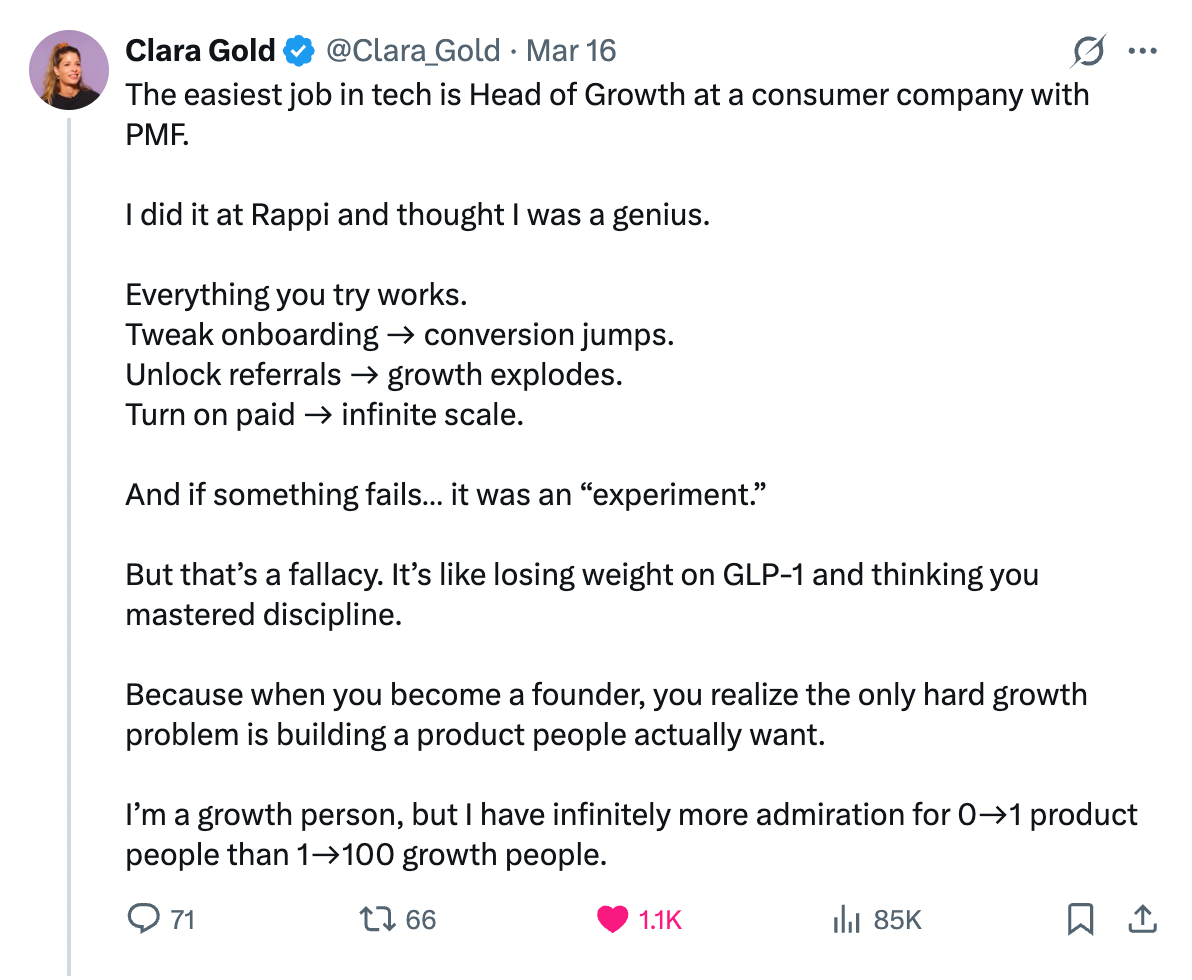
I have very much had this same experience in my own career. At times, I’ve marketed products that everybody wanted. It is like “selling ice cream on a beach on a hot day.” As long as you’re on that beach, you could be slingin' lousy freezer burned popsicles with little more than a crappy sign with “Ice Cream” scribbled on it—yet customers will still flock to you. It’s marketing on easy mode.
At other times I’ve marketed products that the market absolutely needed, but buyers didn’t know it yet. This is much harder—because you have to educate the market first. But once you do, growth starts to come more easily.
And other times still, I’ve marketed products that there just wasn’t much appetite for. In these circumstances, no matter how well you execute everything feels brutally hard.
My point here is simple; if marketing is feeling brutally hard for you, the chances are high that you have a product and market problem more than a marketing problem.
You need to show up when people are searching for a product like yours
Once you know that you’ve built something that people actually want, the challenge of marketing can be distilled simply:
You need to “show up” when people are searching for a product like yours.
This could be via ads. This could be via search. This could be a billboard. DO NOT get lost in channel-level tactics and complexity at this stage. This is where you can really overcomplicate things and where marketing can start to feel very hard if you let it.
Keep bringing yourself back to:
- Where do people search for products like mine?
- What are they actually searching for—what language are they using?
- How can I show up there?
That’s it. These are simple questions, and generally it should not be that hard to answer these.
Let’s say you sell a vacuum and your killer feature is that it has an extra long hose that can easily reach high, hard to access surfaces.
It doesn’t take a rocket scientist to think through how someone might search for such a product—how would you do it? You might search on Amazon, or go to HomeDepot.com. You might type something into Google… with 20 seconds of thought you’ve got a good jump-start on where people search for products like yours already!
The bottle neck here more often than not is that you’re trying too hard to “do marketing” rather than actually stepping into your buyers’ shoes.
You’re proud of your vacuum’s suction power and its extended, 64” hose—so that’s what you talk about in your marketing. Those are the specs!
The problem is no one is searching for a “vacuum with a 64-inch hose.” But there’s a housewife out there Googling “How can I vacuum the ceiling” instead.
Don’t allow yourself to get too lost in the tactics that you’ll use to show up in the right places—these things come and go. If anything, take solace in:
- As opposed to software engineering, the “tactics” of marketing are probably already quite familiar to you. If you’ve sent an email, or made a social media post, or commented on a forum… you can do this!
- Most places where you might want to reach your customers offer paid opportunities where you can “skip the line” and get your message in front of buyers immediately (advertising) as well as free ways to get your message out there (organic search, writing a well known newsletter, etc).
Get your language right and show up in the right places… then there’s only one thing left to do.
Be consistent!
If my call for you to be “comfortable operating in the gray” didn’t already knock you off your horse, this is the one where the remainder of failed marketers fall off.
You just need to show up in the right places, with the right language—probably for years.
This is how you build a brand. This is how you come to be associated with a product category. This is how you become known as a business who reliably solves a particular problem well.
You’ll probably feel like you’re marketing into the void to start, and that’s because you are.
Results may not come quickly, but as you keep chipping away over time, they’ll start to come with increased frequency. This is how compounding builds.
The truth is you need to just keep going.
The graveyard of failed start-ups is littered with founders who searched endlessly for shortcuts—start-up heaven is a gathering of the founders who showed up with the right language and consistency.
What about AI?
More good news—AI is making marketing work easier. Many of the bits that were once hard and tedious are simply no longer so. But as I’ve used AI more and more in my day-to-day marketing work—and listened to the countless conversations on the topic—it’s also clear that once again people are looking for any excuse not to do marketing.
AI is a (powerful) tool, not a marketing strategy
AI represents an incredibly powerful tool that you can and should use in your marketing work. It does not represent a marketing strategy.
Are good companies going to hire an AI CMO? No.
Are you going to be able to plug AI into your tools, and let it just run marketing for you? No.
Not if you want to do this stuff well, anyways. While it’s an intoxicating idea, this is the marketing equivalent of a product person saying “Build me a $10M SaaS, make no mistakes!”
Just as AI might be able to build a half-decent MVP—something that represents a starting point—any product person worth their salt knows that it takes so much more to build a good product. You need to handle all the edge cases. You need to think about security. You need to put in mountains of effort beyond what any other slub can just ask AI to do.
And marketing is the same way.
So much of the promise that’s being sold around “AI for Marketing” use cases is an autonomous marketer that never sleeps. Yes—AI can and will increase your marketing output. But when everyone’s running a million agents at once, it only gets harder to make sure you don’t get drowned out in the noise.
Little should change in terms of how we formulate our marketing strategy. AI is simply a tool that helps at the execution layer. It’s an accelerant.
Too many people will buy into promises that won’t be delivered on. Too many people will actually become less productive, blindly following AI down rabbit holes that didn’t need exploring. Too many people will actually become less capable as they outsource their thinking instead of learning to think critically. Don’t let this be you, dear reader!
Find the ways in which AI works best for you.
Be mindful of magic pills and vendors of complexity
Like most people, I’m personally using Claude as my AI tool of choice at work. As I’ve used it more, I found myself wondering whether I should be using Claude Code versus “Regular Claude” for my marketing work. The more I dove into Claude Code, the more apparent the learning curve became. I (naturally) asked Claude about it—his answer surprised me.
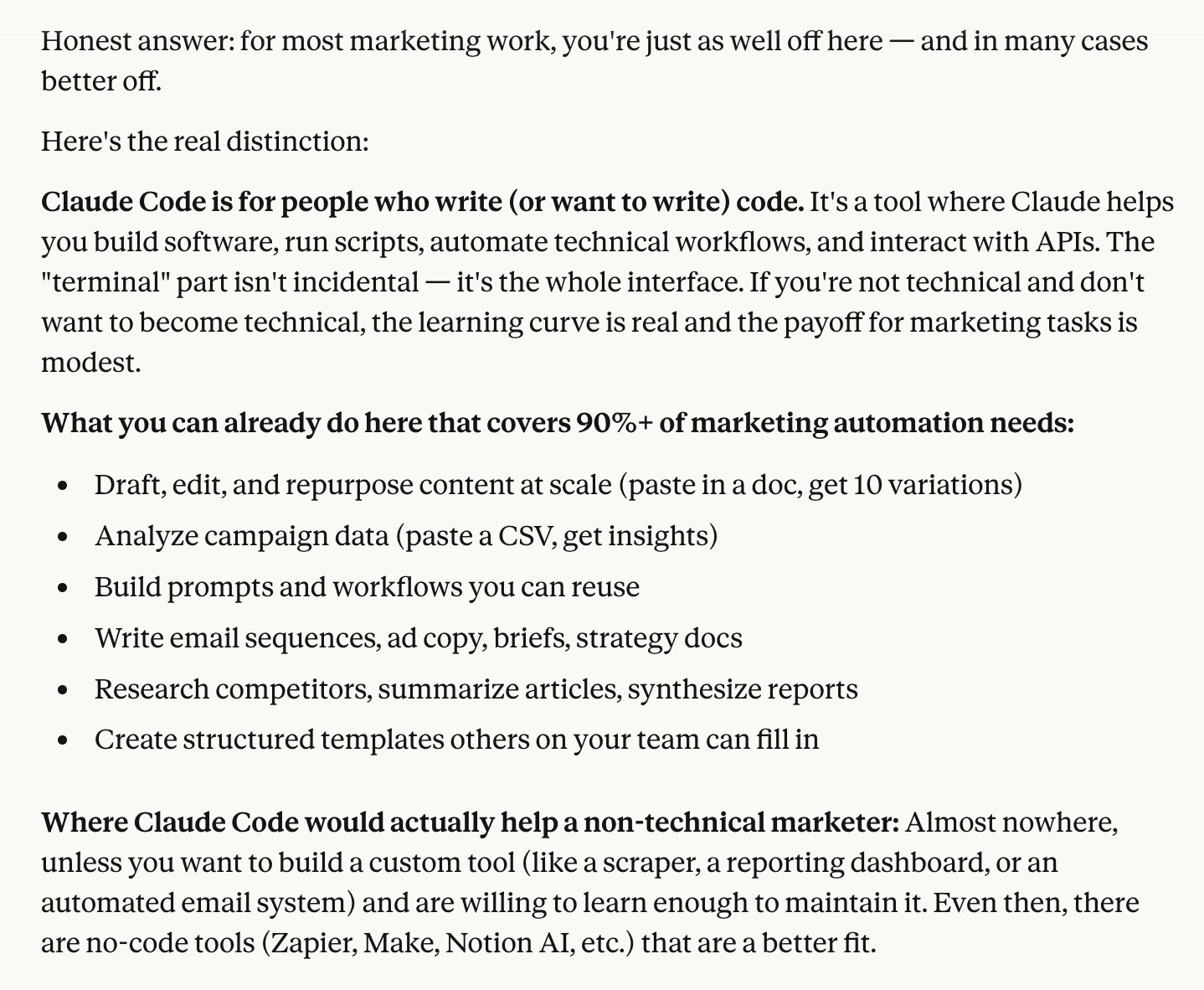
As I’ve played with both, I think this is mostly right. If you’re a technical person or an engineer, I think you should definitely use Claude Code. There are advantages and you can certainly build things with greater complexity. But if that’s not you, I wouldn’t suffer from too much FOMO. There’s so much you can do with “Regular Claude” and automation tools, too.
While tech folks LOVE complexity and pushing the limits of what they can do, business building rewards those who build and maintain the most simple systems.
I experienced this myself when I set out to build a hyper-automated email prospecting workflow using tools like Builtwith, Hunter.io, Claude Code, and Instantly. And then again when I built a workflow to automatically edit and add thumbnails to videos.
Both resulted in hours figuring out terminal commands. Installing packages. Reading up on ffmpeg. It was fun, but I realized through this process that I could actually build a simpler and more effective workflow for email prospecting with a Google Sheet and Zapier. And in the time I spent on the video thumbnail workflow, I could have created all of the thumbnails that I needed for the next year manually in Canva.
The market awards no points based on the complexity of your AI workflows.
How I'm using AI in my marketing work today
These are the workflows where AI is absolutely killing it for me (in terms of marketing).
Research
People are too quick to celebrate things like “autonomously” sending a billion email messages and too slow to celebrate things like efficiency gains in research. You could automate sending a billion email messages long before AI, but the efficiency gains that AI affords in terms of various types of research are just wild.
A simple example—writing customer comparison pages. Ask Claude scan Reddit and review sites to find points frustration with your competitors’ products, that specifically map to things your product does really well. This sort of research used to be tedious—now it’s done in minutes.
Data Analysis
This is by far the biggest one for me. Because Outseta is a system of record that includes customer, payment, product engagement, and support data I have this incredibly rich data set at my fingertips—if only I could mine it for insights!
Whether it’s analyzing why customers churn or the characteristics of our highest LTV customers, AI is an MBA-level data analyst at your fingertips. And it’s great at building actionable plans based on the data too. Plenty of the ideas will be junk or will be missing important context that only you have on your business, but the good ideas should end up on your Trello board.
Editing Copy
I recently wrote a letter to our customer base which introduces Outseta’s next big thing—it’s an incredibly important communication to our customers and the market at large. I wrote it myself, over several days, and really tried to make it all it could be. I thought it was pretty good.
Then I dropped it into Claude, asked for feedback on clarity, making it more concise, and adding a stronger hook.
The end result was significantly better.
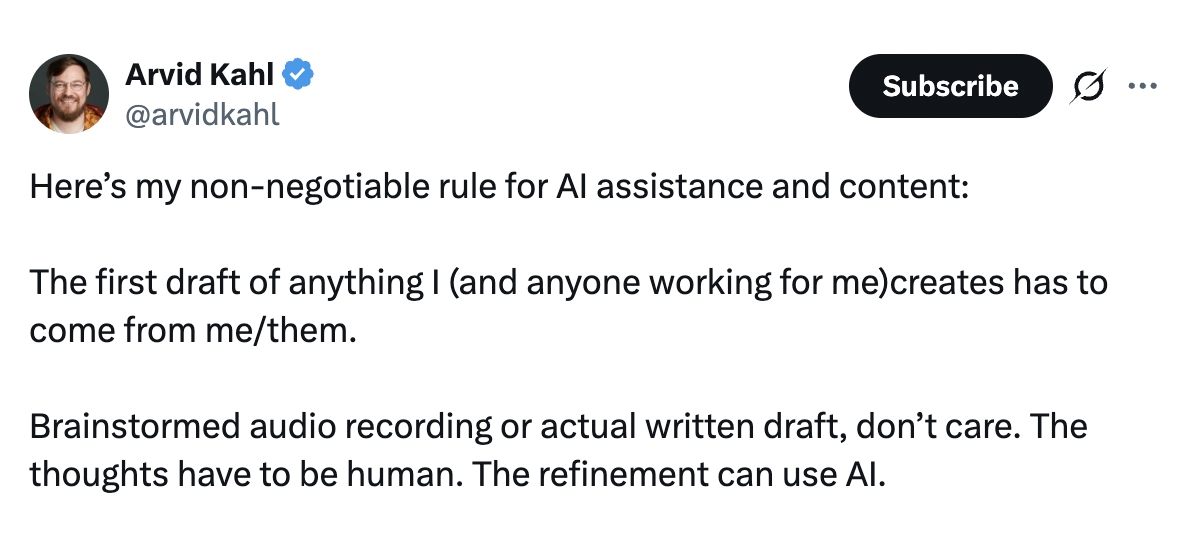
I love this take from Arvid Kahl—it's where I've landed on AI's role in creating content, too.
Riffing on ideas
This one takes many formats. A recent example is I was toying with the idea of naming our AI support chat avatar—it’s designed to help answer technical questions. I thought the name “Dev” or “Deven” made a lot of sense. I asked AI to riff on ideas with me—I got back:
- Reed Onley
- Webb Hook
- Justin Case
- Grant Auth
- Jay Sonna
Is this terribly important work? No! But it’s great to have a thought partner you bounce silly ideas like this off of with ease.
Technical Implementation Plans
I use this one all the time, too—because of the nature of our product, people in a pre-sales context reach out all the time asking us how to build very specific types of digital products. More often than not, these are detailed descriptions of complex products—often beyond the capabilities of what the person asking the question knows how to build.
Historically, that often put us in a strange position—we wanted to be helpful, but the truth was a detailed response could take hours to compile and we’re not in the business of figuring out the architecture for people’s products for them.
Now whenever we receive these plans, we can simply ask AI and get back a very detailed plan on how to build out the product in question. It may not be perfect, but it’s almost always a really accurate 80%-of-the-way-there head start on how to build something.
AI for “back office” work
As I look at the ways in which I’m using AI for marketing today, it’s clear that the time saving is in “back office” type of work—this is the research, analysis, editing, and automation of other tedious tasks that I referenced. I’m not using AI yet to push anything directly to customers.
I think at least for me, that’s right. The customer relationship is sacred—I care about how we show, how often we show up, and the impression that we make. I want to maintain that filter.
We’ve seen the influx of those magical “personalized” emails crafted with AI:
“Hey Geoff,
I see that you’re the founder of an all-in-one membership software product, Outseta. I loved your latest blog “Outseta Company Update - March 2026.” Really valuable insights for other builders. Anyways, did you know I can generate 30 demos for you every day?!”
I continue to think we need marketing that’s more personal and more human—this is not a role that I’m looking for AI to play.
Claude, make it simpler
I started this post by distilling the work of marketing into three simple steps. If you’re feeling lost or marketing is feeling hard, I’d encourage you to just relentlessly return to this list and keep making improvements in these areas. Then look up—you’re marketing!
AI has also arrived to make so much of the work easier; just check yourself to make sure you’re actually working on the things that matter.
But perhaps the most counterintuitive insight for me this year has been a simple one.
Armed with the most powerful technology I’ve ever held in my hands, the most useful prompt I find myself returning to is all of 4 words:
“Claude, make it simpler!”
That’s all I’m asking of you.
Try Outseta free for 7 days—you'll have access to every feature. Cancel any time.

On this page
Get our newsletter